|
 |

|
SALAAT /
DAILY PRAYERS - Fiqh |
|
.. |
The
Messenger of Allah (saw) said: "For everything there is a
face and the face of your religion is prayers. So see to it that
none from amongst you damages and disfigures the face of his
religion." (Source: Biharul Anwar, Volume 82, Page
209) & "If Your Salaat is accepted then all
your other deeds /Aamal are accepted"
|
Salat or Namaz is
the most important and a complete system of worship in Islam.
Literal meaning of salat
is DUA. Considering salat as insignificant or taking it
lightly (Istekhfaf-e-Salat) is a major sin. Both Quran and Ahadeeth
emphasize that the salat must be given top priority in our daily
life and must never be taken as a lightly or secondary thing.
(A) Holy
Quran: Establish salat and do not be among mushrikeen (Surah
Rum, 30:31)
(B) Holy Quran: And woe to the worshippers (namazi), who
are careless in their salat, (Surah Maun, 107:3-4)
(C) Hadeeth Holy Prophet (saw) : If salat is accepted by
Allah, all good deeds will be accepted, & if salat is rejected,
all good deeds will be rejected.
(D) Hadeeth 6th Imam (AS): One, who considers salat as
insignificant, will not receive our shafaat. (Intercession)
A person, who
offers salat, but does not care about the masail (rules and laws) of
salat, is like one who considers salat as insignificant. For some
persons, the lack of knowledge of some masail of salat, wudu and
ghusl, may be an acceptable excuse, but for many other persons, the
lack of knowledge is no excuse, and the Islamic sharia may require
such persons, in some cases, even to repeat the salat of whole life
with the correct method. Hence it is necessary for every
Muslim to know and understand the masail of salat carefully so that
he gains full benefit of this act of worship and he is also not
considered as one who is careless about salat. |
The Holy
Prophet (saw) said: "At the (appointed) time of every prayer
(Salaat), I hear a caller who calls and says: 'O children of Adam!
keep up prayers in order to extinguish the fire you have lit against
yourselves (by committing sins)." Mustadrak-ul-Wasail,
vol.3, p.102
|
|
36th Greater Sin: Omitting
Prayer Intentionally |
|
|
|
|
|
|
THE INCORRECT PRAYERS Imam Al-Baqir (a.s.)
narrates: One day the Messenger of Allah (s.a.w.w.)
was seated in the mosque when a person entered and
began praying, but in a manner such that neither did
he perform his ruku’ (bowing), nor his sujood
(prostration) in a correct manner. Observing this,
the Messenger of Allah commented: “(This person)
pecks as a crow pecks. Should he die and the state
of his prayers be as they are now, he shall surely
not die upon my religion.” (Al-Mahajjatul Baidha,
Volume 1, Page 34)
CARELESSNESS
TOWARDS PRAYERS
The Messenger of Allah
(peace be upon him and his progeny) has said:
“Prayer is the pillar of your religion and one who
intentionally forsakes his prayer has destroyed his
religion. And one who does not guard the times of
the prayers, shall be made to enter ‘Wayl’, which is
a valley in Hell, as Allah, the Exalted, has said:
“So woe to the praying ones, who are unmindful of
their prayers.” (Biharul Anwar,Volume 82, Page
202)
The
Holy Prophet [s.a.w.w.] said: "Be careful of the
prayers, for, on the Day of Resurrection, when Allah
the Exalted, will bring the servant (for reckoning),
the first thing that He will ask him about will be
the prayer. If one brings it completely, he will be
of the people of salvation, otherwise, he will be
thrown into Fire." (Bihar-ul-Anwar, vol. 82, p.
202)
|
|
|
|
IMPORTANT
POINTS OF SALAAT - Notes
From Moulana Sadiq Hassan
|
Salat or Namaz is the most
important and a complete system of worship in Islam.
Literal meaning of salat is DUA. Considering salat as
insignificant or taking it lightly (Istekhfaf-e-Salat)
is a major sin. Both Quran and Ahadeeth emphasize
that the salat must be given top priority in our daily life
and must never be taken as a lightly or secondary thing.
(A) Holy Quran:
Establish salat and do not be among mushrikeen (Surah
Rum, 30:31)
(B) Holy Quran: And woe to the worshippers (namazi),
who are careless in their salat, (Surah Maun, 107:3-4)
(C) Hadeeth Holy Prophet: If salat is accepted by
Allah, all good deeds will be accepted, and if salat is
rejected, all good deeds will be rejected.
(D) Hadeeth 6th Imam (AS): One, who considers
salat as insignificant, will not receive our shafaat.
A person, who offers salat,
but does not care about the masail (rules and laws) of salat,
is like one who considers salat as insignificant. For some
persons, the lack of knowledge of some masail of salat, wudu
and ghusl, may be an acceptable excuse, but for many other
persons, the lack of knowledge is no excuse, and the Islamic
sharia may require such persons, in some cases, even to
repeat the salat of whole life with the correct method.
Hence it is necessary for every Muslim to know and
understand the masail of salat carefully so that he gains
full benefit of this act of worship and he is also not
considered as one who is careless about salat. |
|
CONDITIONS FOR
VALIDITY OF SALAT |
Five conditions must be met
before a wajib salat can be considered as valid (sahih):
(1) Time:
The salat must be offered within the specified time
(2) Qibla: The salat must be offered
towards the direction of Kaba in Makkah
(3) Clothes: The clothes in which salat is
offered must be mubah (lawful), tahir and fulfil other
conditions
(4) Place: The place at which salat is
offered must be mubah, tahir and fulfil other conditions
(5) Taharat: The person’s body must be tahir and
must have performed wudu (or ghusl if required) with
mubah water
(or tayammum, if required, with mubah soil etc)
|
|
IMPORTANCE OF
MUBAH IN SALAT |
|
Mubah means lawfully obtained.
The conditions of clothes, place and water (for wudu or
ghusl) being mubah are extremely important because salat
becomes batil (invalid) if these things are not mubah
(lawfully obtained). If the income of a person is from haram
sources, then the clothes, place and water obtained from
such income automatically become haram and therefore salat
offered using such things is batil (invalid) in most of the
cases.
Fiqh Lecture # 10
Maulana Sadiq Hasan, Panjtan Ctr, Melbourne
One of the most important conditions for a thing to become
mubah (lawful) is that the khums for that thing (if wajib)
must have been paid.
Ignoring the condition of mubah for salat is the same as
taking salat lightly or insignificant (istekhfaf) and
amounts to a great sin.
If khums was wajib on the clothes you are wearing and has
not been paid, and if the salat has been offered in such
clothes, then the salat is batil (invalid) even if you did
not know this rule. In such a case, you must repeat that
salat with mubah clothes on. The same rule applies for the
place or house where the salat is offered, and the water
used for wudu or ghusl, and soil used for tayammum.
If khums was wajib on other items (such as food, car, gifts
etc), which are not used by the person during his/her salat,
and the khums has not been paid on these items, then the
salat is not batil, but the salat will not be accepted until
the wajib khums on these items has been paid. Hence, it is
first necessary to understand the laws of khums and halal
earnings before understanding the detailed masail of salat.
|
|
SOME COMMON
MISTAKES IN SALAT |
In Tashahhud, it is wajib to
pronounce the word as "Muhammadan" and not as "Muhammadun"
after the words "Ashhadu anna".
In Niyyat, the correct wording is "Qurbatan ILALLAH", and
not as "Qurbatan ILLALLAH". However, salat is not affected
even if this wording is pronounced incorrectly as long as
the niyyat in your heart is to seek nearness (qurbat) of
Allah, because the niyyat in your heart is wajib and rukn in
salat and actual saying of that niyyat in words is not
necessary. |
|
MAKROOH
(UNDESIRABLE) DRESS DURING SALAT |
Wearing of following types of
items are makrooh at anytime and during salat and will
reduce the sawab of salat:
(a) Dress with
pictures of a living being (animal or human)
(b) Ring or jewellery inscribed with pictures of
living being
(c) Black dress except that used during azadari
(mourning for Imams AS)
(d) Tattoos on the body unless it is of vulgar type
Four types of black dress
are not makrooh anytime and during salat:
(a) Black turban
(ammama),
(b) Black long robe (aba qaba) worn by scholars,
(c) Black socks,
(d) Black ladies chador (over garment).
It is recommended for ladies to wear some jewellery
during salat.
|
|
TIMES FOR
DAILY SALAT |
In order to work out exact times
for daily salat, it is necessary to gain knowledge of the
following times: Sunset, Midnight, Dawn, Sunrise, Noon.
Mujtahids differ on the definition of Midnight. Scientists
differ on the definition of Dawn. For places on earth
located 45 degrees above or 45 degrees below the Equator, it
is very difficult to determine Dawn time.
Lecture #30 Maulana
Sadiq Hasan, Panjtan Centre, Melbourne
In olden days (when
clocks were not invented), minarets were constructed in
mosques with the purpose of going up the top of minaret and
checking out the times of salat.
Sunset is
defined in two ways:
(a) Astronomical Sunset or Actual Sunset
(published in media), and
(b) Islamic Sunset (which is 10 to 12 minutes
after astronomical sunset or actual sunset) Midnight is
the middle time between actual Sunset and Sunrise times,
according to Ayatullah Khui.
Midnight
is the middle time between actual Sunset and Dawn times,
according to Ayatullah Seestani, Khumaini and Khamenei.
Noon
is the middle time between Sunrise and actual Sunset
according to all Mujtahids
MAGHRIB & ISHA
TIMES:
(a) Maghrib salat time starts with Islamic sunset
(i.e. 10-12 minutes after actual sunset).
(b) Isha salat time starts soon after offering
Maghrib salat.
(c) Maghrib and Isha times remain up to Midnight
(d) It is a sin to delay Maghrib and Isha after
Midnight without genuine reasons (e.g. travel)
(e) Between Midnight and Dawn, you can offer
Maghrib and Isha salat with the intention of Mafiz-zimma
(i.e. neither Qaza nor Ada).
(f) Maghrib and Isha becomes qaza after Dawn, and
it is a sin to make salat qaza.
(g) Fazeelat time for Maghrib (with maximum sawab)
remains for about 35 to 45 minutes after the start of
Maghrib time
(h) Fazeelat time for Isha (with maximum sawab)
starts after the Fazeelat time for Maghrib, and remains
upto initial one-third part of the night.
FAJR TIME:
(a) Fajr salat time starts with Dawn.
(b) Fajr salat becomes qaza at Sunrise.
ZOHR & ASR
TIMES:
(a) Zohr time starts at Noon
(b) Asr time starts soon after offering Zohr
salat
(c) Zohr and Asr become qaza at actual sunset
according to Ayatullah Khui and Seestani with ehtiate
wajib
(d) Zohr and Asr become qaza at Islamic sunset
according to Ayatullah Khomeini and Khamenei
(e) Fazeelat time for Zohr (with maximum sawab)
remains for 1 to 1.5 hours after Noon time according to
Ayatullah Khui.
FASTING TIME:
(a) Fasting time starts with Dawn, and finishes
with Islamic Sunset (i.e. 10-12 minutes after actual
Sunset) according all Mujtahids.
(b) Since it is hard to find actual Dawn, it is
recommended to start fasting 10 minutes before the
published earliest Fajr start time, which is generally
mentioned in timetables as Imsak (when you should stop
eating, drinking etc).
|
|
SOME QUESTIONS & ANSWERS RELEVANT TO
SALAAT
Answer to the Question asked obtained from AyatullahAl-Uzama Sayyid Ali Al-Husaini Al-Seestani Dama
Dhilluhu |
|
Paper # 4
RE DISABLED PERSON |
|
Q) What is the ruling for a
disabled person
who offers prayers
while remaining seated on the chair. Is it correct that such a person joining Namaz must in the beginning stand till Ruku of the 1st Rakaat & then
perform all the actions while seated up to the end bowing wherever possible. Is
it right for this person to lift the sajdagah & place it in the forehead
while reciting the Dhikr of sujood or just bows more without sajdagah touching
the forehead ? ( Sajdagah is
on the small table infront of the Musalli all the time ) |
|
A) Your question is general which requires a detailed reply as it
would apply individually according to his incapacitated position.
In short if he is unable to stand while praying, he should sit
down, & if he is unable to sit, he should lie down. As long as a person
is able to offer prayers standing, he should not sit down. For example, if the
body of a person shakes, or moves when he stands, or he is obliged to lean on
something, or to incline his body a bit, he should continue to offer prayers
standing in whatever manner he can. But, if he cannot st& at all, he should
sit upright, & offer prayers in that position. As long as he can sit,
he should not offer prayers in a lying posture, & if he cannot sit straight,
he should sit in any manner he can. & if he cannot sit at all, he should lie
on his right side. If he also cannot lie on the left side then he should
lie on his back with his feet facing Qibla.
For example, as your question implies, a person is praying seated
on a chair with a table in front of him on which is laid Mor
(Sijdagah). As long as he is able to stand up he should do so & recite Takbiratul Ihram in a standing position & if he can continue standing up to
recite the Qir’at he should continue to do so & perform Ruku & then sit
down to perform Sajdah. If he cannot continue standing up he should sit
down after reciting Takbiratul Ihram & perform Ruku in a sitting
position. If he cannot stand up & recite Takbiratul Ihram then only he
should recite Takbiratul Ihram in a sitting position. If he is offering
prayers in a sitting position, & after reciting Hamd & Surah, he is able to
stand up & perform Ruku, he should first stand up, & then perform Ruku. But if he cannot do so, he should perform Ruku while sitting.
If a person cannot bow down for Ruku properly, he should lean on
something & perform Ruku. & if he cannot perform Ruku even after he has
leaned, he should bow down to the maximum extent he can, so that it could be
customarily recognized as a Ruku. & if he cannot bend at all, he should make
a sign for Ruku with his head.
If a person is supposed to make a sign with his head for Ruku is
unable to do so, he should close his eyes with the niyyat of Ruku, & then
recite Zikr. & for rising from Ruku, he should open his eyes. & if he is
unable to do even that, he should, as a precaution, make a niyyat of Ruku in
his mind, & then make a sign of Ruku with his hands & recite Zikr.
If a person cannot perform Ruku
while standing, but can bend for it while sitting, he should offer prayers
standing & should make a sign with his head for Ruku. & the recommended
precaution is that he should offer another prayer in which he would sit down at
the time of Ruku, & bow down for it.
If a person cannot find something
high on which he may place the mohr, or any other allowable thing,
& if he cannot find any person who would raise the mohr etc. for him, then as
precaution, he should raise it with his h& & do Sajdah on it.
(As regards to raising the mohr with
his h& & do Sajdah on it, Hujjatul Islam Sayyid Muhammad Rizvi has
commented: The basis of your answer is correct; however,
when I compared the statement in the Tawzihul Masa'il with what the
Sayyid has written in Minhajus Salihiyn (which I consider to be more
updated & comprehensive), it seems that the emphasis in the Minhaj is
doing it by ishara rather than bring the muhr by h& to the forehead. In any
case, the issue of bringing the muhr to the forehead is based on ihtiyat
istihbabi, & not ihtiyat wujubi; and, therefore, I would go with the sajda by
ishara as the first choice.)
If a person cannot perform Sajdah at all, he should make a sign for
it with his head, & if he cannot do even that, he should make a sign with his
eyes. & if he cannot make a sign even with his eyes he should, on the basis
of obligatory precaution, make a sign for Sajdah with his hands etc. & should
make a niyyat for Sajdah in his mind, & recite the obligatory Zikr. |
|
Paper
# 25Q]
Please, advise me the doubts in prayers which make
the prayers void & there is no remedy for them? |
|
A] The following doubts make prayers void:
1] Doubts about the number of Rak'ats
occurring in obligatory prayers which consist of 2 Rak'ats, like, Fajr
prayers, or prayers offered by a traveler.
2] Doubts about the number of Rak'ats occurring in prayers consisting of 3
Rak'ats, that is, Maghrib prayers.
3] Doubt occurring in prayers of 4 Rak'ats as to whether one has performed
one Rak'at or more.
4] Doubt in prayers of 4 Rak'ats before going to the second Sajdah, as to
whether he has performed 2 Rak'ats or more.
5] Doubts between 2 & 5 Rak'ats or between 2 & more than 5 Rak'ats.
6] Doubts between 3 & 6 Rak'ats or between 3 & more than 6 Rak'ats.
7] Doubt between 4 & 6 Rak’ats or between 4 & more than 6 Rak’ats.
If a person has one of those doubts which makes prayers void, it is better
for him to break the prayers if the doubt persists. In fact, he should
prolong thinking about it so that the form of namaz changes, or till he
loses all hope to ascertain the situation.
|
|
Paper # 29Q. Please, advise me what are the things (or actions) while praying which would
render the Namaz Makrooh? |
|
A. 1166. It is Makrooh that a person in Namaz slightly turns his face towards
right or left, an angle which would not be construed as deviation from Qibla,
otherwise Namaz will be void. It is also Makrooh during prayers to shut the eyes
or turn towards right or left, & to play with one's beard & hands, & to
cross the fingers of one h& into those of another, & to spit.
It is also Makrooh to look at the writing of the holy Qur'an, or some other
books or a ring. It is also Makrooh to become silent while reciting Surah al-Hamd,
or any other Surah, or Zikr, so as to listen to some conversation. & in fact,
every such act which disturbs attention & humility is Makrooh.
1167. It is Makrooh for a person to offer prayers when he is feeling drowsy, or
when he restrains his urge for urinating or defecation. Similarly, it is Makrooh
to offer prayers with tight socks which press the feet. There are other things
also which are Makrooh in namaz. They are mentioned in detailed books on the
subject. |
|
Paper
# 50PRAYERS Q] Kindly explain to me
what does
silently mean when the Mas’ala says that it is
obligatory for a man & a woman to recite Sura al-Hamd
& the other Surah SILENTLY in Dhuhr & Asr
prayers & also what is the extent of the voice
that should be raised or lowered by a man in the Fajr, Maghrib
& Ishaa prayers? |
|
A] In Salaatul Fajr, Maghrib & Ishaa (JAHR),
when reciting the two Surahs, a man is required to raise his voice to the extent
that the person next to him can hear what is being recited, as in an ordinary
conversation between two persons, while in the third Rak’ah of Salaatul Maghrib
& the third & fourth Rak’ah of Salaatul Ishaa & all four Rak’ah of Salatul
Dhuhr & Asr (IKHFAAT) the person should hear oneself what is being recited.
[For women, all their prayers are performed as IKHFAAT].
(answered by: Sheikh Fadhel Al-Sahlani, the U.S. representative of Ayatullah Al-Udhma
Al-Hajj Al-Sayyid Ali Husaini Al-Seestani Dama Dhilluhu) |
|
Q] Is
it recommended or obligatory for a man to recite
Surah al-Hamd & the other Surah loudly while
offering Fajr, Maghrib & Isha prayers. |
|
A] It is Wajib, but he should not raise his voice
unusually high, as if he were shouting, & if he does so his prayers will be
void. |
|
Q]
Can a person take wages for teaching a person the
act of prayers? |
|
A] To take wages for teaching obligatory acts of
prayers is Haraam, as a precaution, & taking wages for teaching Mustahab
things is permissible. |
|
Paper
#
53/25 Traveller
|
|
Q]
As a result of expansion, some cities which used to
comprise a number of townships, have become very big
ones. Do you consider such cities as one
(physically) or the old demarcations between its
different neighborhoods should be observed? Say, you
set out on a journey heading to some other
destination, from the easternmost point. The time
for prayer was due, while you were still within its
boundaries, that is in the westernmost point. Do you
perform your prayer tamam (in its entirety) or qasr
(shortened form). Also, when you return to such a
big city & the time for prayer was due, while you
were in its outskirts, do you say your prayer qasr
or tamam? & what is the ruling on fasting in such
a situation? |
|
A] As explained in the question, such a city is
considered one, i.e. the rule of different towns is not applicable. Of course,
the yardstick in calculating the distance is the definition of Musafir
(traveler). If such a city is very big & it fulfils the definition, when the
person embarks on his journey from his neighborhood, though it be inside the
city, the rule of Musafir applies here. Thus, the distance is calculated from
the approaches of the neighborhood of the Mukallaf. If the definition does not
apply unless he gets out of the city, the end of the city should be the start of
calculating the distance from the edge of tarakkhus (the point at the parameter
of a town, when, for instance, Adhan “call of prayer” can be heard). |
|
PRAYERS OF A TRAVELLER
If a traveler who wants to stay at a place for ten days, has determined at the
very outset, that during the period of ten days, he will travel to surrounding
places up to the limit of Tarakhkhus or more, & if the period of his going &
returning is so brief, that it cannot be considered as infringement of his
intention of staying there for 10 days, he should offer full prayers.
But if it is considered as an infringement, then he should pray Qasr. For
example, if he is away from that place for a day & a night, then that prolonged
period will be breaking the intention, & he will pray Qasr. But if he was away
for, say, half a day, returning by the evening, it will not be considered as
breaking the intention. Of course, if he travels frequently from that place,
giving an impression that he is visiting two or more places, then he will pray
Qasr.
Question put forward to Maulana Sayyid Muhammad Rizvi based on the above Ruling.
Will the same Mas'ala be applicable, under the same situation, if a traveler who
has decided to stay at a place for more than ten days, did not determine at the
very outset, but travels to a nearby place of more than 28 miles (return) &
returns the same day. For example, he travels in the morning & returns the same
evening or he travels in the afternoon & returns at night. As I understand, he
will be required to pray Qasr during his traveling but will continue to pray
full on his return of stay at a place where he had decided to stay for more than
ten days.
Answer given by Sayyid Muhammad Rizvi.
By looking at the ruling, yes, if a person did not have that intention from the
very beginning & changes his plan in between, then for the remainder of his
stay, he will have to pray Qasr unless the remainder days are 10 days.
Marhum Ayatullah Al-Khoei (a.r.)
If a traveler, who wants to stay at a place for ten days, has determined at the
very outset that, during the period of ten days, he will go to different sides
of that place up to the limit of Tarakhkhus or more, & if the period of his
going & return is, for example, about one or two hours which is not usually
inconsistent with ten days' stay, he should offer complete prayers. & if the
period is more than that, he should, as a precautionary measure, offer shortened
as well as complete prayers, & it that period is full day or the larger part of
it, he should offer shortened prayers. |
|
Paper
# 62 CLOTHES IN
PRAYER
Click
here for MP3 lecture
Lec_21_17th_June_07 |
|
Q.] If a person prays wearing dress which has been purchased with
the money whose Khums has not been paid, is his prayers valid? |
|
A.] If a person purchases a dress with the
particular sum of money whose Khums has not been paid by him, then Namaz in
that dress will amount to the Namaz in a dress which has been usurped. |
|
Q] Is the validity of Namaz adversely
affected if a person prays wearing a Najis pair of socks or cap? |
|
A] If small dresses belonging to a person offering
prayers, like his socks or scalp cap, which would not ordinarily cover his
private parts, become Najis, & if they are not made of the parts of a
carcass or an animal whose meat is Haraam to eat, the prayers offered with them
will be in order. & there is also no
objection if one offers prayers with a Najis ring. |
|
Q) If a person prays with a Najis
dress because of forgetfulness, is his/her prayer
valid? |
A) If a person forgets that his body or dress is
Najis, and remembers during Namaz, or after completing Namaz, as an obligatory
precaution, he should offer the prayers again, if his/her forgetting was due to
carelessness. And if the time has lapsed, he should give its Qadha.
If it was not due to carelessness, and he remembers after completing the Namaz,
his Namaz is valid, but if he remembers during the Namaz, then he should act as
explained below:
If he has ample time at his disposal while offering prayers and he realizes
during the prayers that his clothes are Najis, and he suspect that they may have
been Najis before he started the prayers, he should wash it, or take it off (and
in the case of body he should wash that Najasat off his body), provided that in
so doing, his prayers does not become invalidated and continue his Namaz to its
completion. But if he has no other dress to cover his private parts, or washing
the dress or taking it off, or washing that Najasat off his body, may invalidate
his Namaz, he should, as an obligatory precaution, repeat his Namaz with Pak
clothes.
In the event the time at his disposal is short, under the same circumstances
explained above, he should complete his Namaz in the same state, and his Namaz
will be valid. |
|
Follow up Question. What is he
required to do if he only doubts whether his body or
dress is Pak? |
|
A) If he doubts whether his body or dress is Pak,
and if he did not find anything Najis after investigation, and prayed, his Namaz
will be valid even if he learns after Namaz that his body or dress was actually
Najis. But if he did not care to investigate, then as an obligatory precaution,
he will repeat the prayers. If the time has lapsed, he will give its qadha. |
|
Follow up Question. What is the status of his
prayers if person washes his dress, and becomes sure
that it has become Pak, and offers his prayers with
it, but learns after the prayers that it had not
become Pak? |
|
A) His prayers are in order. |
|
Q]
Can a person in Namaz carry (not wearing) Najis
things with him? |
|
A] Yes, it is permissible for him to carry Najis
things, like handkerchief, key & knife. Similarly , if he has a separate Najis
dress which he is carrying, it will not affect the validity of his prayers.
[Note: It does not include carrying carcass of a Mayta]
Wearing of following types of
items are makrooh at anytime and during salat and will
reduce the sawab of salat:
(a) Dress with
pictures of a living being (animal or human)
(b) Ring or jewellery inscribed with pictures of
living being
(c) Black dress except that used during azadari
(mourning for Imams AS)
(d) Tattoos on the body unless it is of vulgar type
Four types of black dress
are not makrooh anytime and during salat:
(a) Black turban
(ammama),
(b) Black long robe (aba qaba) worn by scholars,
(c) Black socks,
(d) Black ladies chador (over garment).
It is recommended for ladies to wear some jewellery
during salat.
|
|
|
BACK TO MAIN
PAGE | |
Madressa manual notes
times of Namaz- rules
Mushtarik( common) times:
The time
between the special times of zohr and asr is the common time of these 2 namaz.
But, during this time too, zohr will be recited first, followed by asr.
Similarly the time between the special times of maghrib and isha is the common
time of maghri-isha. In this time, too, maghrib will be recited first followed
by isha.
Ending
time of Maghrib and Isha:
Time for
isha namaz ends at midnight. If someone has not recited maghrib and isha by
midnight, then he should recite maghrib-isha as soon as possible, before subh e
sadiq; and without doing niyyat of ada or qaza. Under certain conditions of
no-control eg sleep, forgets, the time of maghrib-isha is till subh e sadiq. Masla
724 , 728
Method
to find out time of namaz: masla 730 , 733
Find out
the times of namaz by any one of the methods stated below:
1.} when
you are sure that the time of namaz has set in. eg, you yourself have decided
the time by seeing the sky, sun, etc. nowadays there is too much light in cities
and even in some villages which makes it very difficult to find out the time of
subah kaazib, subah saadiq and maghrib.
2.} from
clocks and reliable namaz timing charts. Such charts are available for all
cities.
3.} from
adhan of masjids or hearing about it from someone, when you are nearly
sure(itminan) that the muezzin or the person who has told you knows to recognize
the times of namaz..{ chk - # 730}
Rule
: masla 737
If someone has not recited zohr and the special time of asr sets in, first
recite asr in its special time with the niyyat of ada, then recite zohr with
niyyat of qaza.
Similarly if someone has not recited maghrib and the special time of isha sets
in, first recite isha with niyyat of ada, then recite maghrib without niyyat of
ada or qaza.
Chapter # 33 Satar
(covering)
Satar means to cover. In islam details of every act and ibadah have been taught.
This includes those of satar.
Satar in general :
It is wajib for every man and woman to cover his/her private parts (place of
urination and passing stools) from other people and children who can understand.
In addition, it is wajib for a woman to hide her entire body, hair of the head
and beautification/decoration from na mehram men. Exposing the face and the
hands upto the wrist is allowed with some conditions. In certain circumstances
it is necessary to cover even these parts.
Explanation
Mehram:
are the close relations of men and women between whom shariat has not demanded
covering up eg son-mother, aunt-nephew, grandfather and granddaughter,
brother-sister etc are mehram for each other.
v
Na-mehram:
Besides the mehram, all men and women are na mehram of each other, even if they
are close relatives eg first cousins, brother in law-sister in law etc.
Shariat
demands covering up between namehram.
Satr in
namaz :
For men:
in namaz a man is expected to cover up at least both his private parts, whether
there is an onlooker or not. It is better to cover from the navel to the thighs.
Explantion:
this rule shows that the namaz of children who recite namaz in underwear
jaez and correct
For
women:
It is wajib for a woman to cover the entire body including the hair on the
head. It is ehtiyat and sawab to cover the soles of the feet as well.
However,
it is not necessary to cover that part of the face that is washed in wudhu,
hands till the wrist, feet till the ankles. Still it is necessary to cover a
little extra to ensure that the required portions have been covered
Additional
explainations:
{ # 777 – it is ehtiyat e
wajib for a woman to cover her entire body including the hair of the head even
from herself. Eg simply putting a chador on the head is not enough within which
she can see her neck or arms or any other part of the body.
Masla 777 ( shown practically
with help of namaz chadar)
Chapter
# 34Qibla
Qibla
means a place to turn to. Allah has declared the ka’ba , qibla for muslims.
Khaana e
Kaaba is in the city of mecca. It is called the house of Allah. It was built by
Hazrat
Ibrahim
a.s. and Hazrat Ismail a.s.by the orders of Allah. The masjid surrounding the
ka’ba is called “Masjidul Haram”. It means the respected masjid
It is
wajib to face the qibla on 4 occassions:
1.} In Namaz
2.} in the state of Ehtezaar {when the soul leaves the body at the time of
death}
3.} in the grave , the dead body should be turned towards the qibla.
4.} During Zabeeha the animal should be turned towards the qibla.
It is haram to urinate or pass stools either facing the qibla(stomach
& chest towards qibla)
or turning the back to the qibla..(
# 55 – on the basis of E.W )
If a person is reciting naamaz standing, it is necessary that his face, chest,
and stomach face the qibla. It is ehtiyat and sawab that the toes of feet point
to the qibla. ( #
765)
Chapter
# 35dress
of the Namazi
the
dress of the recite should meet he following 6 conditions:
Fehrist
|
1.} dress should be paak. |
4.} it should not be made of any part of a Haraam flesh animal.
|
|
2.} dress should be mubah |
5.} dress of a male should not be of pure silk.
|
|
3.} dress should not be made of any part of a murdaar. |
6.} fress of males should not have been woven/embroidered with gold.
|
Tashreeh:
1.}
dress should be paak : rule 787 , 801
In
normal conditions namaz in a najis dress is not jaez.
2.}
dress should bemubah : Rule 808
The
dress of the namazi should not be gasbi(usurped). The dress should either belong
to him or he should have the permission of the owner to use it.
3.}
should not be made of parts of a murdar(an
animal which has not been islamically slaughtered)
Eg
dress
made of skin of a murdaar goat is najis and the namaz recied wearing it
will be batil.
4.}
dress should not have be made of parts of a Haram fleshed animal
(those
animals whose meat is forbidden for eating):masla
812
Eg:
namaz recited while wearing dress made of skin of cat, fox, rabbit etc is batil.
5.}
Dress of men should not be of pure silk: masla
822 , 824
Namaz in
a dress made of a mix of soot and silk is
correct, but makrooh. (check
this).
Women are allowed to recite namaz wearing dess made of silk.
6.}
Dress of men should not be woven /embroidered with gold.
masla 819
For a
man reciting namaz in a dress with gold thread is batil. women are permitted to
wear such a dress for namaz.
Rule :
even besides namaz, it is haramfor men to wear clothes of pure silk/ with gold.
Similarly, it is haram for me to wear rings, chains, buttons (check), spectacles
made of gold. If he weras these things in nama, the namaz is batil. the articles
which havebeeen declared hram by religion do not become jaez even on joyous
occassions
Rule: chk translation
on the basis of ehtiyate wajib if, in a society, a man wears a dress which is
worn only by women,{ eg saari, gharaara} or a woman wears a dress which is worn
only by men(eg sherwani etc)and he /she considers this to be a zeenat
(beautification) and makes it a habit of wearing such a dress, then it is haram.
However, the namaz recited wearing such a dress will be correct.
Masla 833
Mustahabdress: masla 852
Certain
things are mustahab in a dress of the namaz reciter.
( acc. To fuqaha)
1.} white dress 3.} applying perfume
2.} clean dress 4.} wearing an Aqeeq ring
Makruh
dress: masla 853
Certain
things are makrooh in a dress of the namaz reciter.
( acc. To fuqaha)
1.} black dress
2.} dirty dress
3.} tight fitting dress
4.} a dress/ ring with picture of a face .
Chapter # 36Place
of Namaz
The
place of namaz should meet the following conditions
List
|
1.} place should be mubah |
4.} place should be spacious enough |
|
2.} place should not be moving |
5.} place of sajda should be paak |
|
3.} it should be possible to be able to finish the namaz in that palce |
6.] there should be distance between men and women |
7.}
place should be nearly leveled.
Expalnation:
1.}
place should be mubaah: masla 854
The
place of namaz should not be gasbi. The place should either belong to you, or
you should have the permission of the owner to use it.
2.}
place should not be moving : masla 867 , 868
If you
are compelled to recite namaz in a moving vehicle, plane or boat, as far as
possible do not recite any zikr during jolting.
3.} it
should be possible to finish namaz at that palce: rule
870 –
3rd condition
tauzeeh
There
should be ehtemal ( a low chance) that the recite will be able to finish the
namaz there. Hence avoid reciting namaz in crowds or where the sun, water etc
will interfere with the namaz.
4.}
place should be spacious enough
There
should be enough space to do the qayam, ruku, sajda properly.
5.}
Place of sajda should be paak: 5th
condition
Besides
the place of sajda, if the place of namaz is najs ,it should not be so wet that
it will make the body or clothes of the reciter najis. But if the place of
resting the forehead in sajda is dry, but najis, still the namaz is batil.
6.}
there should be distance between man and women:
masla 874 , 875 Image
If men
and women are reciting namaz in one place eg in a room, then the woman should
either stand more than 10 handspans in front of him, or (on basis of ehtiyate
wajib) she should stand so much behind him that the place on the floor her
forehead touches in sajda should not be beyond the place where the man puts his
knees on the floor for sajda.
Note
that such situations can often arise in homes when brother-sister, husband
–wife, recite namaz at the same time.
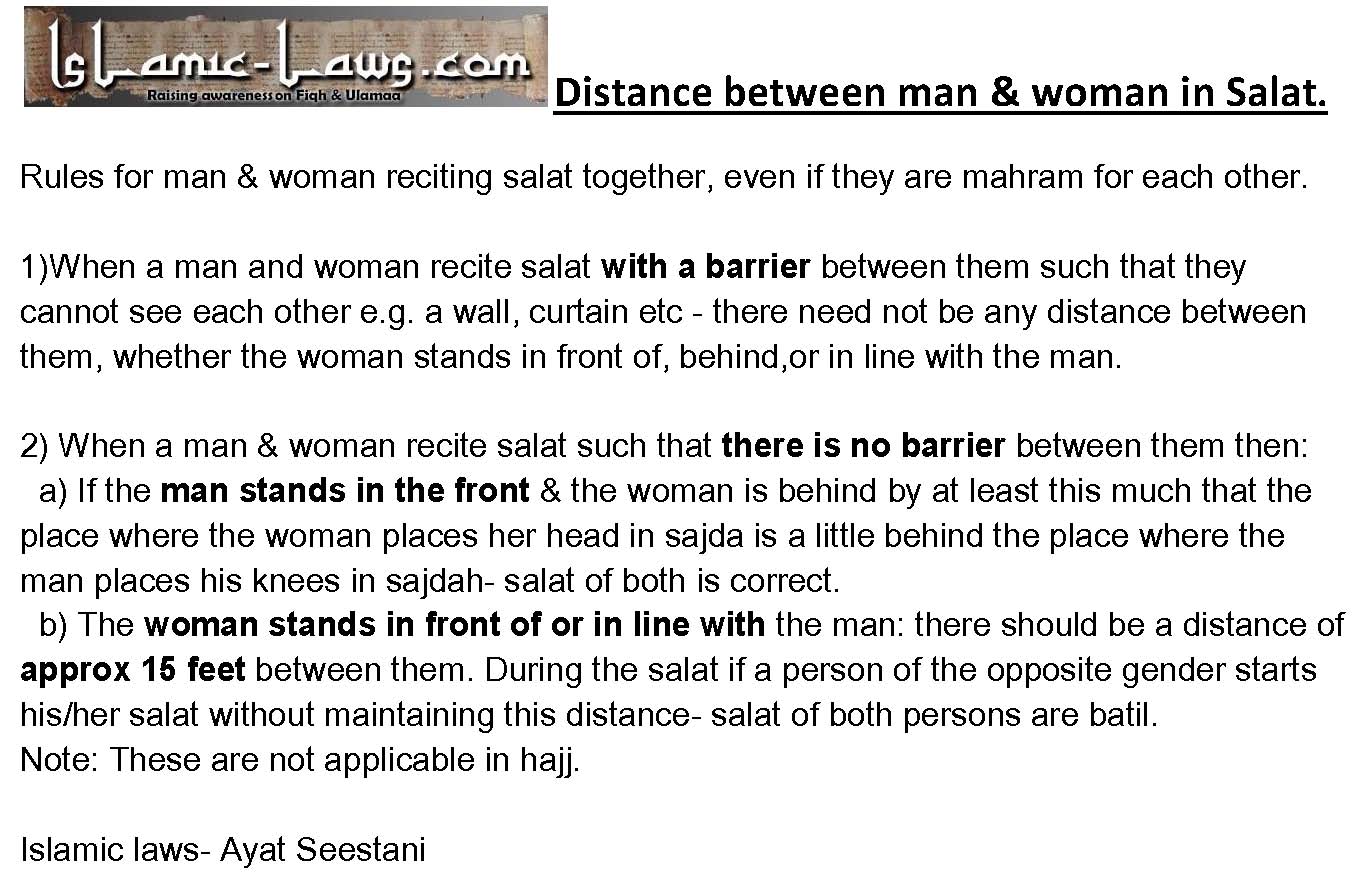
Rules
for man & woman reciting salat together, even if they are mahram for each other.
1)When a man and woman recite salat with a barrier between
them such that they cannot see each other e.g. a wall, curtain etc - there need
not be any distance between them, whether the woman stands in front of,
behind,or in line with the man.
2) When a man & woman recite salat such that there is no
barrier between them then:
a) If the man stands in the front & the woman is behind
by at least this much that the place where the woman places her head in sajda is
a little behind the place where the man places his knees in sajdah- salat of
both is correct.
b) The woman stands in front of or in line with the man:
there should be a distance of approx 15 feet between them. During the
salat if a person of the opposite gender starts his/her salat without
maintaining this distance- salat of both persons are batil.
Note: These are not applicable in hajj.
7.}
place should be nearly levelled: Rule 876 ,
877
the
difference in the height or the slope of the place of standing and doing sajda
should not be less or more than 4 joined fingers.
Places
mustahab for namaz. : rule 880
Shariyat
has stressed a lot that namz should be recited in masajids. The best amongst the
masajids is masjidul haram. After this in order come masjidun nabawi,masjid e
koofa, masjid e baytul muqaddas, the central masjid of every city, masjid of the
locality, masjid of the bazaar.
For
women it is better to pray at a place where she will be more protected from na
mehram, whether such a place is a masjid, her house or any other place. Rule
881 , 855
Chapter
# 37
Waajibaat e Namaz
Maslas
: 929 ,930 , 935 , 945 , 946 .965 ,992 , 1009 , 1032 , 1033 ,1087 , 1095 ,1101
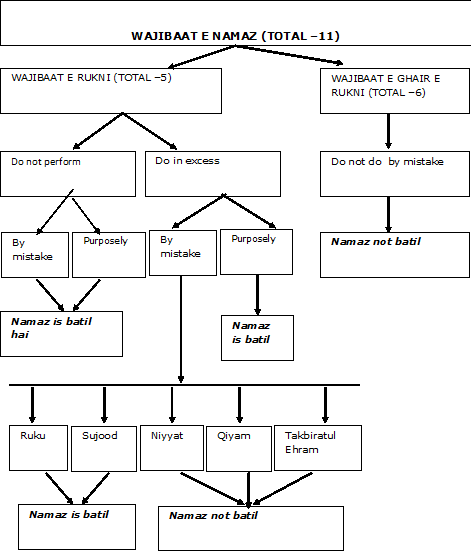
Things
which must be said & done in namaz are called wajibate namaz.
In all
wajibate namaz are 11, of whch 5 are called ruknay namaz and the remaining 6 are
called ghair e rukn. Besides wajibat e naaz other actions (eg qunoot) and
recitations or azkaar (eg istighfar) are mustahab
explanation:
Waajibaat e Rukni:
These 5
wajibaat namz are rukn. Purposely doing these in exess or omitting these will
make namaz batil. If these are left out by mistake, still the namaz is batil .
Doing an extra ruku (doing 2 ruku instead of one in 1 rakat), by mistake, will
make namaz batil. doing 2 extra sajdas, by mistake, in any one rakat will also
make the naamz batil, on basis of ehtiyate wajib (doing 4 sajda instead of 2 in
any 1 rakat)
Waajibaat e Ghair e Rukni:
These
are the wajibaat which when not done purposely will make namaz batil. naaz is
still correct of you omit these by mistake. But in this
case you have to follow the specific rules ..?
. Magar
is surat may jo okum diye gaye hai in par amal karna hoga.
List:
Waajibaat e Rukni;
1.}
Niyyat
2.}
Takbeeratul ehraam and its qayam
3.}
Qayam connected to the Ruku {meaning you have to go to ruku from qayam}
4.} Ruku
5.}
Sujood
Waajibaat e Ghair e Rukni:
6.}
Qirat and Qayam while reciting qirat
7.}
Zikr e Ruku, Zikr e Sujood
8.}
Tashahud
9.}
Salaam
10.}
Tarteeb
11.}
Muwaalaat
{See
chart of ‘wajibaat e namaz’ next pg # 34}