|
 |

|
Friday
(JumU'ah )
prayers |
|
Ayatullah Khoie considers it 'Ehtiyat
e Wajib' to attend the Juma prayers, if all conditons are established ,while
Ayatullah Sistani considers it as 'Wajib
Takhyiri' (ie You have an option to
choose between Friday & Zuhr ,though Friday prayer is preferred ) .
In case Friday Prayer is recited as Wajib ,then Zuhr
prayer can also be recited but with the Niyat(intention) of 'Rija' (ie May
HE accept & Not mustahab)
|
Law Book | Contemporary rulings |
Q &A
|
Rules Islamic
Seminary
|
Moulana S M RIzvi
Article
|
Sermons
|
Urdu lecture
|
Duas
| |
|
Salat-e-Jumuah From Islamic Laws book |
|
740. * Friday prayers
consists of 2 Rak'ats like Fajr prayers.
The difference between these two prayers
is that Namaz-e-Jumuah has two sermons
before it. Namaz-e-Jumuah is Wajib
Takhyiri, which means that we have an
option to offer Jumuah prayers, if its
necessary conditions are fulfilled, or
to offer Zuhr prayers. Hence, if
Namaz-e-Jumuah is offered then it is not
necessary to offer Zuhr prayer. |
The
following conditions must be fulfilled
for Jumuah prayers to become obligatory:
.^. The time for Jumuah
prayers should have set in. And that
means that the midday time should
have begun to decline. The time for
Namaz-e-Jumuah is the earliest part
of Zuhr. If it is very much delayed,
then Namaz-e-Jumuah time will be
over, and Zuhr Namaz will have to be
prayed.
.^. The number of persons
joining Namaz-e-Jumuah should be at
least five, including the Imam. If
there are less than five people,
Namaz-e-Jumuah would not become
obligatory.
.^. The Imam should fulfill
the necessary conditions for leading
the prayers. These conditions
include righteousness ('Adalat) and
other qualities which are required
of an Imam and which will be
mentioned in connection with the
congregational prayers. In absence
of an Imam qualifying to lead,
Namaz-e-Jumuah will not be
obligatory.
|
The
following conditions should be fulfilled
for the Namaz-e-Jumuah to be correct:
.^. The prayers should be
offered in congregation. Hence,
Namaz-e-Jumuah cannot be prayed
alone. If a person joins
Namaz-e-Jumuah before the Ruku of
the second Rak'at his prayers will
be valid and he will have to add
another Rak'at to complete it. But,
if he joins the Imam in the Ruku of
the second Rak'at then the prayers
may not suffice, and as a measure of
precaution Zuhr Namaz should be
prayed.
.^. Two sermons should be
delivered before the prayers. In the
first sermon the preacher should
praise Allah and exhort the people
to observe piety, and then he should
also recite a short chapter (Surah)
from the holy Qur'an. Thereafter he
should sit down for a while and then
stand up again. This time also he
should praise Allah and invoke peace
and blessings upon the holy Prophet
and the holy Imams and, as a
recommended precaution, seek
forgiveness for the believers. It is
necessary that the two sermons
should precede the Namaz. It will
not be correct to offer the prayers
before the two sermons. And, it is
not permissible to deliver the
sermons before Zuhr time has set in.
It is also necessary that the
preacher should be standing while
delivering the sermons. Hence, if he
delivers sermons while sitting, it
will not be in order. It is also
necessary and obligatory that there
should be a break between the two
sermons by way of sitting down
during the interval for a while. It
is also necessary that the preacher
who delivers the sermons should also
lead the prayers. Taharat may not be
a condition for delivering the
sermons, but as a precaution, it
should be maintained. As far as the
glory of Allah, invocation of
prayers and mercy upon the Prophet
and the Imams are concerned, it must
be rendered in Arabic, but the rest
of it need not be in Arabic. In
fact, if the majority in the
audience are non-Arabs, then as an
obligatory precaution, words of
admonition and exhorting people to
be pious and virtuous should be
delivered in their language.
.^. The distance between the
two places where Namaze-Jumuah are
offered should not be less than one
Farsakh (3 miles). Hence if the
distance between the two places is
lesser and both the prayers commence
at one and the same time both will
be void. And if one of those prayers
precedes the other (even to the
extent of Takbiratul-ehram i.e. the
first Takbir) the one which precedes
will be in order and the other will
be void. If, it transpires after the
Namaz-e-Jumuah is over that another
Namaz-e-Jumuah had commenced earlier
or simultaneously at a distance of
less than farsakh, it will not be
obligatory to offer Zuhr prayers. It
is immaterial whether this
information is received within the
time or later. Moreover, a
Namaz-e-Jumuah can stop another from
being held within the stipulated
distance only if it is itself valid,
comprising of all conditions,
otherwise it cannot have any
prohibitive effect.
|
|
741. * When Namaz-e-Jumuah,
with all its requirements is held, it
will be obligatory to attend it if one
who established it is Imam (A.S.) or his
representative. But in a situation other
than this, joining or attending it is
not obligatory. |
When
attending is obligatory, the following
points must be considered:
.^. The person joining should
be man. Presence in Jumuah prayers
is not obligatory for women.
.^. Freedom. Hence it is not
obligatory for a slave to be present
in Jumuah prayers.
.^. Not being a traveller.
Hence Jumuah prayers is not
obligatory for a traveller,
regardless of whether the traveller
prays Qasr or full prayers, as he
would do if he intends staying for
10 days or more.
.^. Being free from ailment
and blindness. Hence it is not
obligatory for a sick or a blind man
to offer Jumuah prayers.
.^. Not being old. Hence
Jumuah prayers is not obligatory for
old men.
.^. That the distance between
the place a person is and where
Jumuah prayers is going to be held
should not be more than 2 farsakh
(11 Km) and it would be obligatory
for a person who is at the end of 2
farsakh to join the Namaz. And
similarly, participation in Jumuah
prayers will not be obligatory for a
person who finds it extremely
difficult, because of rains, severe
cold and so on.
|
742. * A
few rules concerning Jumuah prayers:
.^. It is permissible for a
person, who is exempted from Jumuah
prayers, and for whom presence in
Jumuah prayers is not obligatory, to
hasten for Zuhr prayers in the early
part of its time.
.^. It is Makrooh to talk
while Imam delivers the sermon. And
if the noise created by talking
prevents others from listening to
the sermon, then it is haraam,
regardless of whether the attendance
is the minimum required or more.
.^. As an obligatory
precaution, it is wajib to listen to
both the sermons. However, listening
to the sermons is not obligatory
upon those, who do not understand
their meanings.
.^. The second Adhan on
Friday is an innovation. And it is
the same Adhan which is usually
called the third Adhan.
.^. It is not obligatory for
a person wishing to join Jumuah
Namaz to be present while Imam is
delivering the sermon.
.^. Conducting purchase and
sale at the time when people are
called to Jumuah prayers is haraam,
if it hinders the prayers, and not
if it does not hinder. And in spite
of it being haraam, the transaction
done would not be void.
.^. When it was obligatory
for a person to be present in Jumuah
prayers and he abandoned it, and
offered Zuhr prayers, his prayers
would be in order.
|
|
|
|
Friday (jumu'ah) Prayer From
Contemporary Rulings book |
|
Q24: Does
performing Friday (jumu'ah) prayer
compensate for noon (zuhr) prayer or
not? Is Friday prayer superior to the
noon prayer? |
|
A:
Performing Friday prayer in such a way
that all appropriate conditions are
fulfilled, according to the shari'ah, is
superior to performing noon (prayer). If
the mukallaf performs it (Friday prayer)
as such, then it (Friday prayer)
replaces it (zuhr). (MMS, p. 11, Q5)
|
|
Q25: Is
one entitled to object to the holding of
Friday prayer by claiming that the
marjas of the Muslims in Najaf and Qum
do not establish it, while knowing that
in the city in which the mukallaf
resides, most of the residents perform
Friday prayer on the basis of their fiqh?
|
|
A: One is
not entitled to do that. As for
non-holding of Friday (prayer) by the
marjas, who are of the opinion that it
(Friday prayer) is superior to zuhr
(prayer) and the former replacing it (zuhr),
may be due to personal excuses or the
like. This does not prevent others from
establishing it (Friday prayer). God
knows best. (MMS, p. 12, Q6) |
|
PRAYERS
QUESTIONS ANSWERED BY SHEIKH FADHEL AL-SAHLANI
THE US REPRESENTATIVE OF AYATULLAH AL-UDHMA AL-HAAJ AL-SAYYID ALI
HUSAINI AL-SEESTANI
More QA from Sistani.org
click here |
|
FRIDAY PRAYERS |
|
Q. Please,
advise whether presence of female
congregants would make up the requisite
number of persons necessary for the
Friday Prayer to be established. |
|
A. It is
allowed to calculate males and females
to reach the minimum number which is 5
[including the male Imam] to perform
Salaatul Jumu’ah. |
| Q.
How long can Salaatul Jumu’ah be delayed
for? |
|
A.
Salaatul Jumu’ah cannot be delayed per
se. However, if it is established later
than the actual time, the delay period
will depend upon ‘urf. That is to say,
customarily the community decides what
constitutes delay. |
|
Q. During
Salaatul Jumu’ah, is it permissible to
establish Salaatul Dhuhrayn
simultaneously, either individually or
in congregation? |
|
A. On
Fridays, Salaatul Jumu’ah and Salaatul
Dhuhrayn are optional obligatory. So, if
Salaatul Jumu’ah with all its required
conditions is established, then one has
to join in and cannot pray Dhuhrayn
simultaneously. |
Rules of Friday Prayer ( Source Islamic Seminary)
Friday prayer consists of 2 rakats like Fajr prayer. The
difference between these two prayers is that Namaz-e-Jumuah has two sermons
before it. Namaz-e-Jumuah is Wajib Takhyiri, which means that we have an option
to offer Jumuah prayers, if its necessary conditions are fulfilled, or to offer
Zuhr prayers. Hence, if Namaz-e-Jumuah is offered then it is not necessary to
offer Zuhr prayer.
The following conditions must be fulfilled for
Jumuah prayers to become obligatory:
1. The time for Jumuah prayers should have set in. And that
means that the midday time should have begun to decline. The time for
Namaz-e-Jumuah is the earliest part of Zuhr. If it is very much delayed, then
Namaz-e-Jumuah time will be over, and Zuhr Namaz will have to be prayed.
2. The number of persons joining Namaz-e-Jumuah should be at
least five, including the Imam. If there are less than five people,
Namaz-e-Jumuah would not become obligatory.
3. The Imam should fulfill the necessary conditions for leading
the prayers.
The following conditions should be fulfilled for the
Namaz-e-Jumuah to be correct:
The prayer should be offered in congregation. Hence,
Namaz-e-Jumuah cannot be prayed alone. Two sermons should be delivered before
the prayer. The distance between the two places where Namaz-e-Jumuah are offered
should not be less than one farsakh (3 miles). Hence if the distance between the
two places is lesser and both the prayers commence at one and the same time both
will be void. And if one of those prayers precedes the other the one which
precedes will be in order and the other will be void.
When attending is obligatory, the following points must be
considered:
1. The person joining should be man. Presence in Jumuah prayer
is not obligatory for women.
2. Freedom. Hence it is not obligatory for a slave to be present
in Jumuah prayer.
3. Not being a traveler. Hence Jumuah prayer is not obligatory
for a traveler, regardless of whether the traveler prays Qasr or full prayers,
as he would do if he intends staying for 10 days or more.
4. Being free from ailment and blindness. Hence it is not
obligatory for a sick or a blind man to offer Jumuah prayer.
5. Not being old. Hence Jumuah prayer is not obligatory for old
men.
6. That the distance between the place a person is and where
Jumuah prayer is going to be held should not be more than 2 farsakh (11 Km) and
it would be obligatory for a person who is at the end of 2 farsakh to join the
namaz.
It is permissible for a person, who is exempted from Jumuah
prayers, and for whom presence in Jumuah prayers is not obligatory, to hasten
for Zuhr prayers in the early part of its time.
It is makrooh to talk while Imam delivers the sermon.
As an obligatory precaution, it is wajib to listen to both the
sermons. However, listening to the sermons is not obligatory upon those, who do
not understand their meanings.
The second Adhan on Friday is an innovation. And it is the same
Adhan which is usually called the third Adhan.
Salãtu’l-Jum‘a a few reminders Moulana Sy Muhammad Rizvi
http://www.jaffari.org/files/literature/Friday%20Prayer.pdf
Salãtu ’l-Jum‘a: Whether or not it is wãjib?
During the ghaybat (Occultation) of the Present Imam al-Mahdi (a.s.), the Friday
Prayer is wãjib takhiyri.
What does “wãjib takhiyri” mean? It means that you have a choice between two
obligatory deeds: you must do one of them, you cannot miss both.
In our case, it means that you have the duty of doing either the Noon Prayer or
the Friday Prayer.
However, it is preferable to do the Friday Prayer. And when you do the Friday
Prayer, then you will do it with the niyyat of wãjib; and after that you do not
have to recite the Zuhr Prayer.
2. On Whom is Salãtu ’l-Jum‘a Wãjib?
The Friday Prayer, in its wãjib takhiyri form, is wãjib upon the men who are
resident of that city, in good health, and not elderly.
The Friday Prayer is not wãjib upon the women, the traveler, the sick, and the
elderly. HOWEVER, this does not mean that they are not allowed to participate in
the Friday Prayer; it only means that they are exempted from participating in
the Friday Prayer. Considering the Friday Prayer as the most important weekly
religious event in a non-Muslim country,
it is preferable for the women, the traveler, and the elderly to participate in
the Friday Prayer provided it does not cause any inconvenience to them.
The niyyat for these exempted people will still be the niyyat of wãjib when they
participate in the Friday Prayer; and they do not have to say the Zuhr after it.
3. Friday Prayer led by a Sunni Imam.
If there is no Shi‘a centre or mosque near your home or work-place, then you can
participate in the Friday Prayer led by a Sunni imam. However, in this case, you
will also have to recite the Zuhr Prayer after it. One of the conditions for the
imam of jamã‘at, in Shi‘a fiqh, is that the imam must be ‘ãdil (of upright
character) and Shi‘a Ithnã-‘Ashari.
4. What If I Missed the Khutbas before Jum‘a?
The two khutbas (sermons) delivered by the imam of jum‘a are essential parts of
the Friday Prayer ceremony. The audience is required to listen to the khutba,
and not engage in any other activity, not even doing the nãfila/sunnat prayer.
However, if a person missed the khutbas, he or she can still join the Friday
Prayer and it will be considered sufficient.
5. Discipline & Order
Remain silent when the imam is reciting the surahs. Straighten up the rows of
jamã‘at. Do not recite the zikr so loud that the imam hears them. Hasten in
filling the gaps when the iqamah is being recited. Do not go into the ruku or
sujud before the imam.
Urdu lectures on
Friday Prayer
Friday duas from duas.org
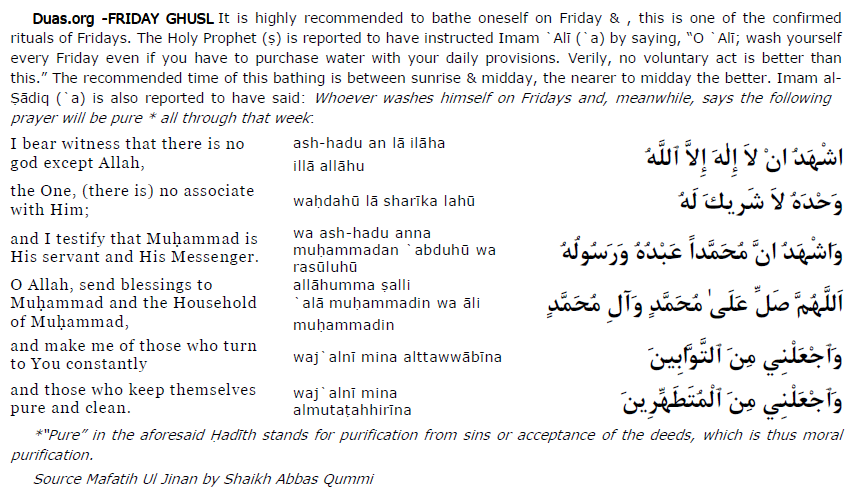
GHUSL & Dua ON Friday
GHUSL :Holy
Prophet said:"O Ali! People must bathe [at least] once every seven days, so
do Ghusl (bathe) every
Friday, even if you have to buy the water with [the money set aside for] your
provision of that day and go without food, for there is no recommended act of
worship greater than it."[Reference: Bihar al-Anwar, vol. 81, p. 129, no. 18] Dua
Image
And it is Mustahab to recite the following supplication
while performing Friday Ghusl:
'Ash hadu an la ilaha il lal lahu wahdahu la sharika lah
wa
ash hadu anna Muhammadan 'abduhu wa Rasuluh. Alla humma
salli 'ala Muhammadin wa Ali Muhammad waj'alni minat tawwabina waj'alni
minal mutatahhirin.
I testify that there is none to be worshipped but Allah alone, Who has no
associate and Muhammad is His servant and Messenger. O Allah! Bless
Muhammad and his Progeny. And make me one of those who are repentant and
pure).
Friday Sermons
Prior to the Friday Prayer, the Imam is supposed to deliver two
sermons. The first sermon is regarding praise and glorification of the Almighty
Allah and also to exhort the people piety and good deeds. The current affairs
and most crucial issues of the Muslim society are also discussed in this sermon.
Then a chapter of the Holy Quran is recited and the first sermon is concluded.
After this the speaker sits down for a while, recites Salawat thrice and then
stands up again to deliver the second sermon.
For the benefit of prayer leaders we present below the second
Friday sermon in Arabic:
الْحَمْدُ لِلَّهِ رَبِّ الْعَالَمِينَ. اللَّهُمَّ لَكَ الْحَمْدُ بَدِيعَ
السَّمَاوَاتِ وَ الْأَرْضِ، ذَا الْجَلَالِ وَ الْإِكْرَامِ، رَبَّ الْأَرْبَابِ،
وَ إِلَهَ كُلِّ مَأْلُوهٍ، وَ خَالِقَ كُلِّ مَخْلُوقٍ، وَ وَارِثَ كُلِّ شَيْءٍ،
لَيْسَ كَمِثْلِهِ شَيْءٌ وَ هُوَ بِكُلِّ شَيْءٍ مُحِيْطٌ اَنْتَ اللهُ لآَ
اِلٰهَ اِلاَّ اَنْتَ الْاَحَدُ الْمُتَوَحِّدُ الْفَرْدُ الْمُتَفَرِّدُ وَ اَنْتَ
اللهُ لآَ اِلٰهَ اِلاَّ اَنْتَ الْكَرِيْمُ الْمُتَكَرِّمُ الْعَظِيْمُ وَ
الصَّلٰوةُ وَالسَّلاَمُ عَلٰي مُحَمَّدٍ نَبِيِّ الرَّحْمَةِ سَيِّدِ
الْمُرْسَلِيْنَ وَ عَلِيِّ ابْنِ اَبِيْ طَالِبٍ سَيِّدِ الْوَصِيِّيْنَ وَ
فَاطِمَةَ الزَّهْرَآءِ سَيِّدَةِ النِّسَآءِ الْعٰلَمِيْنَ وَ حَسَنِ الْمُجْتَبٰي
حُجَّةِ اللهِ عَلَي الْخَلْقِ اَجْمَعِيْنَ وَ الْحُسَيْنِ الشَّهِيْدِ
الْمَظْلُوْمِ وَارِثِ اَمِيْرِ الْمُؤْمِنِيْنَ وَ عَلِيِّ بْنِ الْحُسَيْنِ
زَيْنِ الْعَابِدِيْنَ وَ مُحَمَّدِ بْنِ عَلِيٍّ بَاقِرِ عِلْمِ الْاَوَّلِيْنَ وَ
الْاٰخِرِيْنَ وَ جَعْفَرِ بْنِ مُحَمَّدِ نِ الصَّادِقِ الصِّدِّيْقِ وَ
الْمُقْتَدِيْ بِاٰبَآئِهِ الصَّالِحِيْنَ وَ مُوْسَي ابْنِ جَعْفَرِ الْكَاظِمِ
مِنْ اَوْلاَدِ النَّبِيِّنَ وَ عَلِيِّ ابْنِ مُوْسَي الرِّضَا مِنْ عِتْرَةِ
بَرَرَةِ الْمُتَّقِيْنَ وَ مُحَمَّدِ ابْنِ عَلِيِّ الْجَوَادُ وَلِيِّ
الْمُؤْمِنِيْنَ وَ عَلِيِّ بْنِ مُحَمَّدِ السِّرَاجِ الْمُنِيْرِ اِمَامِ
الْخَاشِعِيْنَ وَ الْحَسَنَ بْنِ عَلِيٍّ سَيِّدِ الْاَوْصِيَآءِ
الْمُنْتَجَبِيْنَ وَ الْخَلَفِ الْقَآئِمِ الْمَهْدِيِّ الْمُنْتَظَرِ الْحُجَّةِ
بَعْدَ اٰبَآئِهِ عَلٰي خَلْقِكَ الْمُوَدِّيْ عَنْ نَبِيِّكَ وَ وَارِثِ عِلْمِ
الْمَاضِيْنَ مِنَ الْوَصِيِّيْنَ الَّذِيْ بِبَقَآئِهِ بَقِيَتِ الدُّنْيَا وَ
بِيُمْنِهِ رُزِقَ الْوَرٰي وَ بِوَجُوْدِهِ ثَبَتَتِ الْاَرْضُ وَ السَّمَآءُ وَ
بِهِ يَمْلاَءُ اللهُ الْاَرْضَ قِسْطًا وَّ عَدْلاً كَمَا مُلِئَتْ ظُلْمًا وَّ
جَوْرًا وَّ عَجِّلْ لَّنَا اَللَّهُمَّ ظُهُوْرَهُ اِنَّهُمْ يَرَوْنَهُ بَعِيْدًا
وَ نَرَاهُ قَرِيْبًا بِرَحْمَتِكَ يَآ اَرْحَمَ الرَّاحِمِيْنَ. اَللَّهُمَّ
افْتَحْ لِيْ اَبْوَابَ تَوْبَتِكَ وَ رَحْمَتِكَ وَ رِزْقِكَ الْوَاسِعِ اِنِّيْ
اِلَيْكَ مِنَ الرَّاغِبِيْنَ وَ اَتْمِمْ لِيْ اِنْعَامَكَ اِنَّكَ خَيْرُ
الْمُنْعِمِيْنَ اَللَّهُمَّ اجْعَلْ بَاقِيْ عُمْرِي فِيْ اَدَآءِ فَرْضِ
الْجُمُعَاتِ وَ الْحَجِّ وَ الْعُمْرَةِ ابْتِغَآءِ وَجْهِكَ يَا رَبِّ
الْعٰلَمِيْنَ وَ صَلَّي اللهُ عَلٰي مُحَمَّدٍ وَّ اٰلِهِ الطَّيِّبِيْنَ
الطَّاهِرِيْنَ وَ السَّلاَمُ عَلَيْهِ وَ عَلَيْهِمْ.
Transliteration: Bismillaahir Rah’maanir Rah’eem. Al
H’amdu lillaahi rabbil a’lameen. Allaahumma lakal h’amdu badi’ as-Samaawaati wal
arz” dhul jalaali wal ikraam. Rabbal arbaab wa ilaaha kulli maaloohin wa
khaaliqa kulli makhlooqin was waaritha kulli shayyin laisa ka mithlihi shayyun
wa huwa bi kulli shayyin muh’eet’ antal laahu laa ilaaha illallaaha illa antal
ah’adul mutawah’h’idul fardul mutafarrid wa antal laahu laa ilaaha illa antal
kareemul mutakarrimul a’z’eem. Was’ s’alaatu was salaamu a’laa muh’ammadin
nabiyyir rah’ma, sayyidil mursaleen wa a’liyyibni Ani T’aalib sayyidil was’iyyin
wa Faat’imataz Zahra sayyidatin Nisaail a’lameen wa H’asan al-mujtaba h’ujjatil
laahi a’lal khalqi ajmae’e’n wal H’usainish Shaheed al Maz’loom waarithi ameeril
mo-mineen wa a’liyyibnil h’usain Zainul a’abideen wa muh’ammadibni a’lyyin
Baaqiri i’lmil awwaleena wal aakhireen wa Ja’faribni muh’ammad as’-S’aadiqis’
s’iddeeq wal muqtadi bi aabaaihis’ s’aalih’een wa moosabni ja’faril kaaz’im min
aulaadin Nabiyyin wa a’liyyibni moosar riz”a min I’trati bararatil muttaqeen wa
muh’ammadibni a’liyyil jawaadu waliyyil mo-mineen wa a’liyyibni muh’ammadis
Siraajil muneer imaamil Khaashie’e’n wal h’asanabni a’liyyin sayyidil aus’iyaail
muntajabeen wal khalafil qaaim al Mahdi al muntaz’ar al h’ujjati ba’da aabaaihi
a’laa khalqikal muwaddi a’n nabiyyika wa waarithi I’lmil maaz”eena minal
was’siyyin al ladhi bi baqaaihi baqiyatud duniya wa bi yumnihi ruziqal waraa wa
bi wajoodihi thabatatil arz”u was samaa wa bihi yamlaul laahul a’rz”a qistanw wa
a’dla kamaa muliat z’ulmanw wa jaura. Wa a’jjil lanaa allaahumma z’uhoorahu
innahum yaraonahu bae’e’eda wa naraa ahu qareeba. Bi Rah’matika yaa ar h’amar
raah’imeen. Allaahummaf tah’ li abwaaba tauba taubatika wa rah’matika wa
rizqikal waasi-I’ inni ilaikum minar raaghibeen wa atmim li ina’amaka innaka
khairul mun-i’meen. Allaahummaj a’l baaqi u’mri fee adaai farz”il Jumua’ati wal
h’ajji wal u’mratib tighaai wajhika yaa rabbil a’lameen wa s’allallaahu a’laa
muh’ammadinw wa aalihit’ t’ayyibeenat’ t’ahireen. Was salaamu a’laihi wa
a’laihim.
Translation: In the Name of Allah the Beneficent the
Merciful. Praise be to Allah the Lord of the worlds. O Allah for You is the
praise, the creator of the heavens and the earth. One with might and honor, the
Lord of the lords and the deity of all deities and the creator of all that is
created. He is the inheritor of everything. There is nothing like Him. And He
surrounds everything. You are Allah, there is no god except You. The one, the
single, the unique and the Only. And You are Allah, there is no god except You.
The noble one having nobility and greatness. And bliss and salutations upon
Muhammad the Prophet of mercy, the chief of the prophets. And Ali Ibne Abi Talib
(a.s.), the chief of successors and Fatima Zahra, chief of the ladies of the
worlds and Hasan al-Mujtaba, proof of Allah on all the creatures and Husain the
martyr, the oppressed and the heir of Amirul Momineen and Ali Ibn al-Husain
Zainul Abideen and Muhammad bin Ali al-Baqir, splitter of the former and latter
knowledges and Ja’far bin Muhammad as-Sadiq as-Siddiq and the follower of his
righteous forefathers and Musa bin Ja’far al-Kazim from the posterity of the
prophets and Ali bin Musa ar-Reza from the progeny of the pious and Muhammad bin
Ali al-Jawad, the guardian of the believers and Ali bin Muhammad the luminous
lamp, Imam of those who show utmost humility and Hasan bin Ali the chief of the
noble successors and the successor al-Qaim al-Mahdi, the awaited one, the proof
after his forefathers upon Your creatures and conveyer of the message of Your
prophet and heir of the past successors. By whose survival the world survives
and through whose blessings all get sustenance and for the sake of whose
existence, the heavens and the earth stand. Who would fill with justice and
equity the world which is full of injustice and oppression. O Allah! Hasten his
reappearance for us. Indeed others think him remote but we consider him near. O
the most merciful of the merciful ones. For the sake of Your mercy, accept our
supplications. O Allah! Open for us the doors of our repentance, Your mercy and
a wide sustenance. Indeed we are inclined to You and complete Your bounty upon
us, indeed You are the best of the bounty-givers. O Allah! May our remaining
life be dedicated to the duties of Fridays, Hajj and Umrah and the aim of these
our worship acts should be Your satisfaction alone. O Lord of all the worlds and
bliss of Allah and salutations be on Hazrat Muhammad Mustafa and his pure and
chaste family. Peace be on the Holy Prophet and on them.
Method of Friday Prayer
After the Friday sermons, Iqamah has to be recited and then the
Imam makes intention that he is leading Friday Prayer of two rakats, wajib
qurbatan ilallaah. After that he should recite Takbeeratul Ahraam. In the same
way the follower should also make an intention that I am reciting the Friday
Prayer behind that prayer leader of two rakats, wajib qurbatan ilallaah. Then
the follower must also recite the Takbeeratul Ahraam.
After that the leader has to recite Surah Fatiha and it is
better that after Surah Hamd he should recite Surah Jumua at the end of which he
should say
اَللهُ اَكْبَرُ
Allaahu Akbar and recite the qunoot. It is better to recite the following
supplication in the qunoot:
اَللَّهُمَّ اِنَّ عَبِيْدًا مِّنْ عِبَادِكَ الصَّالِحِيْنَ قَامُوْا بِكِتَابِكَ
وَ سُنَّةِ نَبِيِّكَ فَاجْزِهِمْ عَنَّا خَيْرَ الْجَزَآءِ
Allaahumma inna a’beedam min I’baadikas’ s’aalih’een qaamu bi
kitaabika wa sunnati nabiyyika fajzihim ‘anna khairul jazaa.
O Allah, indeed, servants from Your righteous servants stand by
Your Book and practice of Your Prophet. So reward them on our behalf with the
best of the rewards.
After that perform the ruku and sajdahs. After the two sajdahs
stand up for the second rakat and in the second rakat after Surah Fatiha recite
any other Surah but it is better to recite Surah Munafiqoon. After the second
Surah recite:
اَللهُ
اَكْبَرُ Allaahu
Akbar and go into the ruku. After the ruku straighten up and recite qunoot.
Then perform the sajdahs and after the two sajdahs recite the tashahud and
salaam thus completing the prayer.