|
 |

|
WUDHU, TAYAMMUM & GHUSL |
“O Believers! When you prepare for prayers, wash
your faces and your hands up to the elbows, and
wipe your heads, and your feet to the ankles …
and [if you] do not find water then betake
yourselves to clean earth and wipe your faces
and your hands with it.” (Al-Qur'an: Chapter
5, Verse 6)
NO prayer is
accepted without a correct Wudu, so it is
IMPORTANT for you to learn how to do it, and ask
those who know how to teach you things you are
not sure about.
|
|
|
|
Noor Ahkam 'Film ' explaining Wudhu Ghusl & Salaat
|
Film explaining
Wudhu |
Haditv media | |
|
Salaat
Assessment BOYS (pdf)
Salah assessment Qfatima |
Method/Rulings Shk Saleem |
How
to Perform Wudhu, Tayammum & Ghusl
Prior to performing the daily prayers, and as a
recommended or obligatory prerequisite to other acts of
worship, Muslims must purify themselves – this is
usually done with water. The minor form of this
purification with water is called
Wudhu,
while the major form is called
Ghusl.
If water is not available, the purification
can be performed with clean earth or soil, and is called
Tayammum.
|
|
I
WUDHU 14
urdu lectures click here |
|
When
to Perform Wudhu -
How
to Perform Wudhu -
Mustahabaat of Wudhoo - Jabira
Wudhu(on bandage) -
Questions |
|
When to Perform Wudhu |
|
Every
Muslim must be in a state of spiritual purification before
performing the daily obligatory prayers. The same state of
purification must also be achieved before numerous other
acts of worship, such as optional prayers, touching the
script of the Qur`an and the rites of the pilgrimage (Hajj)
can be performed. In most cases, it is sufficient to perform
Wudhu in order to achieve this purification. However, at
other times, a Ghusl must be performed.
Things that Annul it:
1. After passing urine and
faeces.
2. Passing intestinal or stomach gas.
3. Sleeping in such a way that the ears do not hear and the
eyes do not see,
4. Entering any state of loss of conscience.
These are some of the most important ones, you have to
do more research your self depending your gender.
|
|
How to Perform Wudhu
Pdf |
|
Step
1: Niyyah: Make your intention as, "I am
performing Wudhu for the pleasure of Allah, and to seek
closeness to Him”.
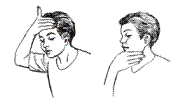 |
Washing the face: First, remove anything on the
face (and hands) that may prevent water from
reaching the skin before beginning Wudhu (physical
items such as a watch, ring, etc… or even things
such as paint or anything which would act as a
barrier over the skin). Take a handful of water in
the right hand and pour this water over the face
from the top (just above the forehead). Then using
the right hand, wipe the face from the tip of where
the hair-line is to the bottom of the chin such that
the water reaches all parts from the hairline to
chin, and the entire horizontal plane of the face
within the reach of the span of the hand from the
middle finger to the thumb. To ensure that all
external parts have been washed, include a bit of
the inner parts of your nose, lips, and eyes in the |
|
washing. You do not, however, need to wash the
complete inner portion of these parts. Washing once
as described above is obligatory. A second such
washing is recommended while subsequent washings are
prohibited. |
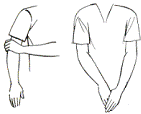 |
Washing the arms: Using the left hand, pour
water over the right arm from the elbow to the
finger-tips and then, with the same hand, wipe the
water over both sides of the arm to ensure that all
parts are washed. Then do the same with the left arm
by using the right hand. The washing must be done
from the elbows to the fingertips and not vice
versa. Pour water from a little above the elbow to
ensure that the whole forearm is covered. Wash in
such a way that the water penetrates the hair, if
any, and reaches the skin. Again, washing once as
described above is obligatory. A second such washing
is recommended while subsequent washings are
prohibited. |
Regarding washing of the face and hands:
.^. Wash by
pouring water from top to bottom. Washing the other way will
invalidate your Wudhu.
.^. In
general, wash a little beyond the required limit in order to
make sure all parts are covered.
^.
In Washing the face and arms,
water must flow over them, even if with the help of the
hand, but rinsing is not enough. The first time
is wajeb and the second time is mustahab and the
third
time is Haram, (forbidden)
You have to be sure that the water you use is 100%
is pure water, and is not ghasby, usurped.
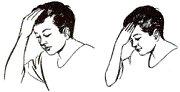 |
Wiping the head: Next, wipe the front
most quarter of the head with the moisture that
remains in your right hand. Wipe from the upper part
of the head downwards (from the back of the head
towards the face). It is recommended to wipe the
length of at least one finger. Wiping can be done
with one finger only; however it is recommended to
use three fingers together (the middle finger, index
finger and ring finger). The moisture must reach the
scalp however if the hair is so short that it can
not be combed, it is sufficient to wipe your hair.
While wiping the head, your hand hould not touch
your forehead. Doing otherwise will cause the water
of the forehead mix with the wetness of your |
|
hands, and this will render the act of wiping your
right foot invalid, since the act of wiping must be
done with the wetness of the hands only.
|
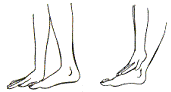 |
Wiping the feet: Finally, wipe your feet
with the moisture that remains in your hands. Wipe
starting from the tip of any toe up till the ankle
joint. Wipe your right foot with your right hand,
and your left foot with your left hand. It is better
to wipe at least the width of three joined fingers
(the middle finger, index finger and ring finger),
and better yet to wipe your entire foot with your
entire hand. At the time of wiping the foot,
actually pull the hand from toes to the ankle joint
(as described above) along the length of the
toe-tips till the ankles. Do not just place your
whole hand on your foot and pull up a little. Please
note that wiping of the feet performed on socks or
shoes is not valid except in |
|
unusual circumstances. |
Regarding wiping of the head and feet:
.^. While
wiping your head and feet, move your hand over them. Keeping
your hand stationary and moving your feet / head under your
hand will invalidate your Wudhu. However, there is no harm
if your head and feet move slightly during the wiping.
.^. The parts
you are wiping must be dry before you begin wiping, and if
they are so wet that the moisture on your palm has no effect
on them, the wiping will be void. Slight dampness on the
part you are wiping is permissible as long as the moisture
of the palm is immediately mixed with it when wiping.
.^. Wiping
must be done with the moisture remaining on the palms after
washing. Do not re-wet your hands with new water, or mix the
moisture on the palms with water from other organs of Wudhu.
In the case where the palms become dry before wiping, the
palms can be re-wet with water from the beard, moustache,
eyebrows, or the other organs of Wudhu.
.^.
the head and feet must be
only wiped once.
^.
Washing is different from
wiping in that in wiping the hand should be only wet and no
extra water is needed as in washing.
LINKS -
|
Play & Learn Link
on Wudhu
|
Wudhu Madressa manual
Islamic
law book-Wudhu section
Dialogue on ablution (Wudhu)
| Demo
film
Urdu Lectures |
|
Mustahabaat of Wudhoo |
|
Use 750 gms
of water – about 1.5 pints. .. Brush your teeth even if it
be with your finger .. Wash your hands upto the wrists twice
if it is wudhoo after visiting the toilet, once if it is
after sleeping. .. Rinse your mouth thrice.. Rinse your nose
thrice .. Wash your face with your right hand .. When
pouring water on your hands start from inside the elbow
(female) .. Recite these
Duas.org of wudhoo .. Begin wudhoo with
Suratul Qadr and end with Ayatul Kursi
|
|
JABIRAH WUDHOO
(Wudu on
a Bandage) |
|
Any
plaster, dressing, or medication which is applied to a wound
or broken bone is called Jabira. Jabira wudhoo is the wudhoo
done on the jabira which is on the parts of the body related
to wudhoo. i.e. to pass the wet hand over the jabira or by
placing a taahir handkerchief over the jabira and passing
the wet hand over it.
(a)
If it is an uncovered
wound or fracture and water does not cause any harm to
it, then wudu
must be performed in the usual manner.
(b)
If the wound or
fracture is covered with a bandage and the bandage can
be removed without causing any harm, and water is not
harmful to the wound, then the bandage should be
removed and then do the normal
wudu.
(c)
If there is uncovered
wound or broken bone and if the use of water would cause
harm to the affected part, the adjoining parts must be
washed. Then place a
paak piece
of cloth over the affected part, and pass a wet hand
over that cloth. But in the case of a fracture,
tayammum
must be performed.
(d)
If the wound or
fracture is covered with a bandage which is
paak and it
is not possible to remove the bandage nor is it possible
to make water reach the wound without any harm, then the
adjoining parts must be washed and wet hands passed over
the bandaged affected parts.
(e)
If the wound or its
bandage is najis,
but it is possible to remove the bandage, and if water
is not harmful for the wound, he should remove the
bandage, make the wound
paak and
should make water reach the wound at the time of
wudu.
(f)
If the wound or its
bandage is najis
and cannot be made
paak, then
tayammum
should be performed.
(g)
If something is stuck
on the part of wudu,
and it is not possible to remove it, or its removal
involves unbearable pain, then one should perform
tayammum.
But, if the thing which is stuck is medicine, then rules
relating to jabira
will apply to it.
(h) If there is no
wound or fractured bone in the parts of
wudu, but
the use of water is harmful for some other reason, one
should per tayammum.
(i)
If
jabira
covers some of the parts of
wudu, then
wudu
prescribed for
jabira is enough. But if all the parts of
wudu are
totally covered in
Jabira, then, as a precaution, one should do
tayammum,
and also do wudu
as per the rules of
jabira.
(j)
If the
jabira has
covered unusually more space than the size of the wound,
and if it is difficult to remove it, then one should
perform tayammum,
except when the
jabira is at the places of
tayammum
itself, in which case, it is necessary that he should
perform both wudu
and
tayammum.
(k)
In all kinds of
ghusls,
except the ghusl
of meyyit,
the jabira ghusl
is like jabira wudu.
However, in such cases one should resort to
ghusle
tartibi.
(l)
If the obligation of a
person is to do
tayammum, and if at some of the places of
tayammum he
has wound or fractured bone, he should perform
jabira tayammum
according to the rules of
jabira wudu.
(m)
If a person cannot
decide whether he should perform
tayammum or
jabira wudu,
the obligatory precaution is that he should perform
both.
If a person who has to
pray with jabira
wudu or
jabira ghusl knows that his excuse will not
be removed till the end of time for
Salaat, he
can offer prayers in the prime time. But if he hopes
that his excuse will be removed before the
Salaat
becomes qazaa,
it is better for him to wait, and if his excuse is not
removed by then, he should offer prayers with
jabira wudu
or jabira ghusl.
And if, however, he prayed in the prime time, and his
excuse was removed before the end of
Salaat time,
the recommended precaution (Sayyid Khoei considers it
necessary) is he should do
wudu or
ghusl, and
repeat the prayers
Jabira wudhoo is done
when:
The bandage is on a wound where the skin is cut or torn,
provided the bandage does not completely cover* any one of
the relevant parts of wudhoo.
There is a splint for keeping a fractured limb in a certain
position, provided that the splint does not completely
cover* any one of the relevant parts of wudhoo.
*For example, if the bandage or splint (jabira) completely
covers a foot, then tayammum must be done. However, if it
covers only part of a foot, with an area visible for masa,
then jabira wudhoo should be done. If it is possible to wash
the wound by removing the bandage, then perform wudhoo as
normal. If it is not possible to take off the bandage, then
wiping the wet hand fully over the bandage will do.
If the bandage is only for pain or swelling, then one should
remove the bandage and perform normal wudhoo, though
tayammum can be done.
If something is stuck on the parts of wudhoo or ghusl, and
it is not possible to remove it, or its removal causes
unbearable pain, then tayammum should be done. However, if
the thing that is stuck is medicine, then the rules of
jabira wudhoo apply.
Like in wudhoo, the rules of jabira equally apply to ghusl.
When you are not sure whether you have to do wudhoo or
tayammum, then both wudhoo and tayammum must be done.
Power point -These slides show what to do
when one has an Obstruction, Bandage, or Medicine on a Part
of Wudhu
A
Dialogue on split (Jabirah)
|
|
II
TAYAMMUM
14 urdu lectures click here
|
Video tutorial |
Video
Demo |
|
When to
Perform Tayammum - How to Perform Tayammum - Things on which
tayammum is allowed - Conditions of tayammum
|
How to Perform Tayammum
Niyya
: Make your intention as, "I am doing
Tayammum in place of Wudhu (or
Ghusl), for the pleasure of Allah and to
seek closeness to Him."
Step 1
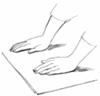
: Strike the palms of both hands
simultaneously on earth, sand, or stone (in
order of preference) which is dry and clean. (Figure
1).
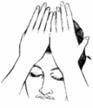
Step 2 :
Pull both palms together from the beginning of
the forehead where the hair grows down to the
bridge of the nose. Both sides of the
forehead joining the ears and over the eyebrows
should be included. (Figures 2 and 3)
Step
3 :
Then pull the left palm on the whole back of the
right hand from the wrist bone to the
fingertips. (Figure 4)
Step 4 :
Then pull the right palm on the whole back of
the left hand.
Step 5 :
Strike the palms together upon a valid surface a
second time as in Step 1.
Step
6 :
Repeat Step 3.
Step 7 :
Repeat Step 4. |
 |
 |
 |
 |
|
Figures 1 |
Figures 2 |
Figures 3 |
Figures 4 |
|
|
When to Perform Tayammum
|
|
Perform
Tayammum in place of Wudhu or Ghusl when:
1. Not enough water is available for Wudhu or
Ghusl.
2. Obtaining water for Wudhu will endanger
your life or property or you are unable to procure
water by any means.
3. Using the available water will leave
insufficient water for drinking and pose a risk of
dying of thirst or illness, or difficulty for
yourself or your dependents.
4. Washing your face and hands with water
will endanger your health.
5. Water is available but you do not have
permission to use it.
6. There is a risk that performing Wudhu or
Ghusl will cause the time of the entire or a part of
the prayer to end.
7. If the body or clothing is ritually impure
(Najis) and the person possesses only as much water
so that if he was to perform Wudhu or a Ghusl, no
more water would be available for making his body or
clothing pure for prayer.
|
|
How to Perform Tayammum
|
Make your Niyya (Intention): I
am doing Tayammum in place of Wudhu (or Ghusl), for the
pleasure of Allah and to seek closeness to Him. Then,
1. Strike
the palms of both hands simultaneously on earth,
sand, or stone (in order of preference) which is dry
and clean. (Figure 1).
2. Pull both palms together from the
beginning of the forehead where the hair grows down
to the bridge.
3. Then pull the left palm on the whole back
of the right hand from the wrist bone to the
fingertips. (Figure 4)
4. Then pull the right palm on the whole back
of the left hand.
5. Strike the palms together upon a valid
surface a second time as in Step 1.
6. Repeat Step 3.
7. Repeat Step 4.
For more detail, refer to The Ritual and Spiritual Purity,
http://al-islam.org/ritualandspiritual/ |
|
Things on which tayammum is
allowed: |
Tayammum can be done on earth,
sand, a lump of clay or stone. Earth is the first choice for
tayammum. If there is no earth then either sand or a lump of
clay can be used. If earth, sand or a lump of clay is not
availabe then a stone can be used. However, one cannot
perform tayammum on minerals e.g. aqeeq, diamonds... If none
of the above are available, then dust which may have settled
on the carpet can be used.
If dust cannot be found then tayammum can be done on wet
earth. If snow or ice is availabe, then you should try and
melt it to do wudhoo. If this is not possible then tayammum
can be done on the snow or ice.
The things on which tayammum is done should be tahir, it
should not be ghasbi or done on a place that is ghasbi.
More
details of things on which tayamum is allowed click here
|
|
Conditions of tayammum |
There are 5 conditions:
1. Niyya If there is only tayammum to be done
then it is not necessary to specify if it is instead
of ghusl or wudhu. If there is more than one
tayammum, then it is necessary to specify the niyya
of each tayammum - whether it is instead of ghusl or
wudhoo.
2. Tarteeb All the acts of tayammum must be
in the correct order.
3. Muwalat The acts must follow each other
without any undue gaps.
4. Tahara The parts of the body on which
tayammum is done must be tahir and not covered. i.e.
no rings, nail polish etc..
5. Under normal circumstances you must do
tayammum yourself.If you are not able to, then
someone can help you perform tayammum.
Those
things which make wudhoo or ghusl batil, also make tayammum
batil.
ADDITIONAL
INFO/LINKS ON TAYAMMUM :-
Tayamum Q& A |
Play
& Learnlink on Tayamum |
Islamic law book Tayamum section
|
Dialogue on dry ablution (Tayamum) from
Jurisprudence made easy book |
More
details of things on which tayamum is allowed
|
Urdu lectures
Tayamum Q& A Click here
|
|
III
GHUSL |
|
Ghusl Details |
|
Ghusl means
'washing' oneself. Unlike wudhoo, it is washing of the whole
body in a particular way. To be able to remove Hadathe Akber
(The big najasat) Ghusl is Wajib. e.g. touching a dead body.
It is Mustahab to do ghusl on Friday before going for
Salatul Jumu'a or on Eid day before Salatul Eid.
There are two ways in which to do ghusl. One is known
as Ghusl Tartibi and the other is known as Ghusl
Irtimasi.
Ghusl Tartibi is done in the following manner:
1. First make sure that there is nothing
which obstructs the water from reaching the skin
.e.g. hair oil, nail polish, lipstick.... It is best
to clean your complete body and then wash off the
shampoo and soap.
2. Do your niyya - It must be Qurbatan
Ilallah. You should know which ghusl you are doing.
3. Firstly it is wajib to pour water over
your head down to the neck. It is mustahab to run
your fingers through your hair so that the water
reaches the roots of the hair and to make sure water
reaches everywhere.
4. Then, it is wajib to pour water the rest
of your body from the shoulder to the feet - the
right side first and then the left side. It is
mustahab to wipe over the body with your hands
whilst doing ghusl to make sure that water has
reached every part. When washing the right side some
parts of the left side must be washed too and
similarly when washing the left side some parts of
the right side must be washed.
Ghusl Irtimasi is done in the following way:
After niyya, the whole body is immersed in water all
at once and the water must reach all parts of the
body including the scalp.
It is
better to do Ghusl tartibi. -
Click here for Ghusl Explained & QA on
Ghusl
MORE LINKS -
Play & Learn GHUSL |
Islamic
Law book Ghusl section |
Dialogue on ceremonial washing (Ghusl) |
Urdu
Lectures on Ghusl |
GHUSL Films/Lectures |
25 Mustahab Ghusl's
video |
|
Power Point
Presentations from
www.madressa.net on Ghusl |
|
Covers all Ghusls Wajib for Men and Women, as well as how to
perform Ghusl |
|
These slides show what to do
when one has an Obstruction, Bandage, or Medicine on a Part
of Wudhu |
|
Covers Details on Ghusls which are Wajib only for Women |
|
Discusses Alternatives to Performing Wudhu or Ghusl
|
|
Explains how to Wash oneself in Preparation for Prayers
|
|
|
|
Questions asked &
answers on Wudhu/Ghusl obtained as per Rulings of Sayyid Ali Al-Husaini Al-Seestani |
|
Q) In Wudhu,
while washing the face is washing of beard
sufficient or is one required to ensure that the
water reaches the skin under the beard? |
|
A) If the skin of the face is
visible from under the hair, one should make the
water reach the skin, but if it is not visible, it
is sufficient to wash the hair, & it is not
necessary to make the water reach beneath the hair.
In case if he doubts whether his skin is visible
from the under the hair of the face or not, he
should, as an obligatory precaution, wash his hair,
& also make the water reach the skin. |
|
Q) As I
understand, washing the face & the hands in Wudhu
once is obligatory & to wash them twice is
recommended.
But I cannot underst& as to which washing should be
considered first or second if I decide to pour water
on my face & hands a number of times? |
|
A) While performing Wudhu, it is
obligatory to wash the face & the hands once, & it
is recommended to wash them twice.
Washing them three or more times is Haraam.
As regards to which washing should be treated as the
first, it will depend upon washing the face & the
hands thoroughly, leaving no room for precaution,
with the Niyyat of Wudhu.
So, if he pours water on his face ten times with the
intention of the first washing, there is no harm,
but when he will then wash with the Niyyat of Wudhu,
it will be called the first time.
Thus, he can go on pouring water on his face several
times, & in the final wash, make the Niyyat of
Wudhu.
But if he follows this procedure, then the face &
the hands should be washed once only, as an
obligatory precaution. |
|
Q) In the course
of performing Masa’ (wiping) in Wudhu, is it
necessary that my head & feet are in a stationery
position when doing so? |
|
A) While wiping one’s head & feet,
it is necessary to move one’s h& on them, & if the head & feet are moved leaving
the h& stationary, Wudhu would be void. However, there is no harm if the
head & feet move slightly, while the h& is being moved for wiping. |
|
Q) While wiping
the feet in Wudhu, is it sufficient to place the
whole h& on the foot & pull a little? |
|
A) As a precaution, at the time
of wiping the foot, one should place one’s h& on the
toes & then draw it to the joint.
Simply placing the whole h& on the foot, & pulling
it a little is not sufficient. |
Paper # 6 |
|
Q) Is it
Wajib to wash the inner parts of the nose, lips &
eyes in Wudhu? |
|
A) While performing Wudhu, it is not obligatory
that one should wash the inner parts of the nose,
nor of the lips & eyes which cannot be seen when
they close. However, in order to ensure that all
parts have been washed, it is obligatory that some
portion of these parts (i.e. inner parts of nose,
lips & eyes) are also included. |
|
Q) During
Wudhu, can “Masa” (wiping) be done on the parts of
wiping which is wet? |
|
A) The parts of wiping should be dry, & if they
are so wet that the wetness of the palm of the h&
has no effect on them, the wiping will be void.
However, there is no harm if the wetness on those
parts is so insignificant, that the moisture of the
palm overcomes it. |
|
Q) What are the conditions for the
validity of Wudhu? |
|
A) The following are the conditions for a correct
Wudhu:
(1)
The water should be Pak, & clean, not sullied with dirt,
even if that dirt is Pak.
(2)
The water should be pure, & not mixed.
(3)
The water should be Mubah (permissible for use).
(4)
The container of the water, used by the person concerned
for Wudhu, should be Mubah (permissible for use by him).
(5)
As an obligatory precaution, the container of the water
used for Wudhu should not be made of gold or silver.
(6)
The body on which Wudhu is performed, should be Pak, at the time of washing & wiping.
(7)
The person doing Wudhu should have sufficient time at
his disposal for Wudhu & namaz.
(8)
One should perform Wudhu with the niyyat of Qurbat i.e.
to obey the orders of Allah. If, a person performs Wudhu, for the purpose of
cooling himself or for some other purpose, the Wudhu would be void.
(9)
Wudhu should be performed in the prescribed sequence,
that is, he should first wash his face, then his right h& & then his left
hand, & thereafter, he should wipe his head & then the feet. As a
recommended precaut ion, he should not wipe both the feet together. He
should wipe the right foot first & then the left.
(10)
The acts of Wudhu should be done one after the other,
without time gap in between.
(11)
A person doing Wudhu should wash his hands & face & wipe
his head & feet himself. Hence, if another person makes him perform Wudhu,
or helps him in pouring water over his face, or hands, or in wiping his
head, or feet, his Wudhu is void.
(12)
There should be no constraint for using water.
(13)
There should be no impediment in the way of water reaching the parts of Wudhu.
|
|
PAPER # 13
|
|
Q) If a
person is sure that he has performed Wudhu, & has
also committed an act which invalidates Wudhu, but
does not remember which happened first, can
he pray without performing a fresh Wudhu? |
|
A) He should act as follows:
(1)
If this situation arises
before his Namaz, he should perform Wudhu.
(2)
If it arises during Namaz, he
should break it & perform Wudhu.
(3)
If it arises after Namaz, that
Namaz will be valid, but for the next prayers he should perform Wudhu. |
|
Q) If a person doubts after Namaz,
whether he performed Wudhu or not, is he required to
pray again?
& if such a doubt occurs during Namaz, what is he required to do? |
|
A) If the doubt is after Namaz, his
prayers offered by him would be in order.
But for the next prayers, he should perform Wudhu.
In the case of the doubt during Namaz, his prayers is
void & he should perform Wudhu & then pray. |
|
Q) Is it
permitted to touch the Names of Allah, the Holy Qur’an , & the names of the Prophet of Islam (s.a.w.w.), the
Imams (a.s.) or Fatema Zahra (a.s.) without Wudhu? |
|
A) It is Haraam, as an obligatory
precaution, to touch the Names of Allah or His Special Attributes without Wudhu,
in whichever language they may have been written. The same is true for the Holy
Qur’an. However, there is no harm in touching the
translation of the Holy Qur’an, in any language, without Wudhu. As for the names of the Holy Prophet (s.a.w.w.)
the Imams (a.s.) & Janabe Fatema Zahra (a.s.) it is
better not to touch their names without Wudhu. |
|
Paper
# 21 |
|
Q)
What are the things for which performance of Wudhu
is obligatory? |
A) It is obligatory to
perform Wudhu for the following six things:
(1) For all obligatory prayers, except
Namaz-e-Meyyit.
(2) For the Sajdah & Tashahhud which a person
forgot to perform during the prayers, provided
that he invalidated his Wudhu after Namaz, &
before performing those forgotten acts. It is
not obligatory to perform Wudhu for Sajdatus
Sahw.
(3) For the obligatory Tawaf of the Holy Ka’bah.
(4) If he has made a Nadhr, or a solemn pledge,
or taken an oath for Wudhu.
(5) If he has made a Nadhr, for which act
requires performance Wudhu. I.e. kissing the
script of the Holy Qur’an.
(6) For washing & making Pak the Holy Qur’an
which has become Najis when he becomes obliged
to touch the script of the Holy Qur’an with his
hand, or some other part of his body.
|
|
Q)
If a person believes that the time of prayers has
set in, & makes the Niyyat of Wajib Wudhu, & then
realizes after performing the Wudhu that the time
for the prayers has not set in, is his Wudhu in
order? |
|
A) Yes, his Wudhu is in order. Note: If a
person performs Wudhu or Ghusl before the time of prayers, in order to be in the
state of purity, they will be deemed valid. & even if he performs Wudhu near the
time of Namaz, with the Niyyat of preparing himself for Namaz, there is no
objection. |
|
Q)
If a person performs Wudhu for an act for which it
is Mustahab to perform Wudhu, i.e. Namaz-e-Meyyit,
visiting the graves, entering a Mosque, etc. can he
pray with the same Wudhu? |
|
A) Yes, if he has performed Wudhu for any one of
the above purposes, he can commit all acts which require Wudhu. For example, he
can even pray with that Wudhu. |
|
Paper
# |
|
GHUSL Q] Is it a condition for the validity of Ghusl
that one’s entire body must be Pak before one
commences to perform Ghusl? |
|
A.378] It is not necessary that the entire body of
a person should be Pak before Ghusl. So, if the body becomes Pak while pouring
water over one’s body with the intention of the Ghusl, the Ghusl will be in
order. |
|
Q]
Is the validity of Ghusl adversely affected if there
exists a thing stuck on the body which would prevent
water from reaching the skin? |
|
A.383] All things which prevent water from
reaching the body should be removed. If a person does Ghusl before ensuring that
such obstacles have been removed, the Ghusl will be void. |
|
Q]
Is it necessary to include washing of hair in Ghusl? |
|
A.385] While doing Ghusl, one should wash the
short hair which are taken as a part of the body. Washing of the long hair is
not obligatory. |
|
Q] If a person
does any act which would make the Wudhu void while
he is performing Ghusl, will his Ghusl become void &
should he start all over again? |
|
A.392] If one does any act which would invalidate
the Wudhu while doing Ghusl, one does not have to abandon the Ghusl & start all
over again. In fact, one can continue with the same Ghusl till completion.
However, in this situation, one will have to do Wudhu also, as per obligatory
precaution. |
|
Paper
# 49 |
|
GHUSL Q) Is washing of hair obligatory in Ghusl? |
|
A) While doing Ghusl, one should wash the short
hair which are taken as a part of the body. Washing of the long hair is not
obligatory. However, if one makes water reach the skin in such a way that those
long hair do not become wet, the Ghusl is in order. On the other hand, if it is
not possible to make water reach the skin without washing the hair one should
wash the hair so that water may reach the body. |
|
Q)
Is there any difference in the conditions for the
validity of Tartibi Ghusl with the ones stipulated
for Wudhu? |
|
A) All the conditions for the validity of Wudhu
also apply to the validity of Ghusl except:
(a) For Ghusl it is not necessary that the body be washed downwards.
(b) It is not necessary to wash the body immediately after washing the head &
the neck. There is no harm, therefore, if there is a lapse of some time after
washing one’s head & neck before washing one’s body. It is not necessary that
one should wash one’s head, neck & body in one instance. |
|
Q)
In the event one urinates or passes wind (or does
any act which would invalidate the Wudhu) while
doing Ghusl, is he required to abandon the Ghusl &
perform the Ghusl again? |
|
A) No, he does not have to abandon the Ghusl &
start all over again. In fact, one can continue with the same Ghusl till
completion. However, in this situation, one will have to do Wudhu also, as per
obligatory precaution. |
|
Paper
# 67 |
|
1) It is not
necessary that the entire body of a person should be Pak before Irtimasi or
Tartibi Ghusl. So, if the body becomes Pak while diving in water or pouring
water over one’s body with the intention of the Ghusl, the Ghusl will be in
order. |
|
2) While doing Ghusl, if a part
of the body, however small, remains unwashed the Ghusl is invalid. But, it is
not obligatory to wash the inside of the ear or nose and other places which are
reckoned to be the interior of the body. |
|
3) All things
which prevent water from reaching the body should be removed. If a person does
Ghusl before ensuring that such obstacles have been removed, the Ghusl will be
void. |
|
4) At the time of Ghusl, if one
doubts whether there is something on one’s body which would prevent water from
reaching the body, one should investigate and satisfy oneself that the obstacle
is not there and if it is there he should remove it. |
|
5) While doing
Ghusl, one should wash the short hair which are taken as a part of the body.
Washing of the long hair is not obligatory. However, if one makes water reach
the skin in such a way that those long hair do not become wet, the Ghusl is in
order. However, if it is not possible to make water reach the skin without
washing those hair one should wash them so that water may reach the body. |
|
6) When a person is in doubt
whether he or she has done Ghusl or not, such a person must do Ghusl. However,
if doubt arises in the mind after Ghusl as to whether Ghusl was correct or not,
then there is no need to do Ghusl again. |
|
7) If one
urinates or passes wind (or does any act which would invalidate the Wudhu) while
doing the Ghusl, one does not have to abandon the Ghusl and start all over
again. In fact, one can continue with the same Ghusl till completion. However,
in this situation, one will have to do Wudhu also, as per obligatory precaution. |
|
8) A person who has more than
one Ghusl to do can do one Ghusl with the Niyyat of the rest. In fact, one Ghusl
with its Niyyat is enough to represent all others. |
|
9) A person who
does Ghusl of Janabat should not do Wudhu for the prayers. In fact one can offer
prayers without performing Wudhu after all Wajib Ghusls (except the bath for
“medium istihaza”). |
|
NOTE: All the conditions for
the validity of Wudhu (e.g. the water being pure and not having been usurped)
also apply to the validity of Ghusl. |
|
Tayamum Q& A Click here
|
|
Women Related Wudhu /Ghusl Issues
Books:-
Ritual Ablutions for
Women
|
Women Issues made simple |
|
BACK TO MAIN PAGE |
|
Chapter # 26
WuDHU
Definition and obligation
The
definition and purpose of wudhu”
Wudhu is
washing and wiping(masah) certain parts of the body in a specified way, in order
to obtain the qurbat (pleasure) of Allah. Wudhu is a worship. One who does wudhu
gets inner purity. By ordering us to do wudhu, Allah does not want to trouble
us, rather this order is to make us taahir
Rule
315: Things for which wudhu is wajib.
1.
Wajib namaz except namaz e mayyat
2.
To perform forgotten sajda and forgotten tashahhud.
3.
To perform the wajib tawaf of the Ka’ba.
4.
When one
has done nadhr, ehed or taken a qasm to perform wudhu
Rule:
Sunnat namaz are not correct , if performed without wudhu: Rule
315
Rule:
It is
haram to touch any part of the body to the words of the Quran without wudhu, be
they (transliterated) in any language eg, rumi, Gujarati etc.
It is
not haram to touch the translation of the Quran without wudhu (rule 316)
Rule:
On the basis of ehtiyat, it is haram to touch the names of Allah, be they in any
language
Rule: It
is
better
not to touch the names of Paigamber e Akram (s.a.w.s) and aimma (a.s) without
wudhu . Rule 318
Occassions for wudhu is mustahab.
Rule 321
Doing
wudhu is mustahab on many occasions. Some of these are:
1…………..
For Namaz e Mayyat
2…………..
For reciting the Quran.
3…………..
for entering a masjid.
4…………..
For visiting dead in the graveyard..
5…………..
at the time of sleeping
Chapter
# 27
Wudhu –Method
There
are 9 actions in wudhu, of which the 1st 3 are mustahab and the
remaining 6 are wajib.
Mustahab
Actions :
1.}……………. Washing both hands
2.}……………. rinsing the mouth with water, thrice
3.}
…………… rinsing the nose with water, thrice.
Rule
If time
for namaz is less, it is necessary to drop the mustahabaat, do wudhu quickly and
recite namaz within its time.
Wajib
Actions :
4.}
washing the face: lengthwise: the face should be washed from above the forehead
from where hair of the head grows to the chin. Breadthwise: the area of the face
covered between the middle finger and the thumb should be washed. To ensure that
the required areas are washed wash a little extra area. Rule 236
5)
washing the right arm: wash from the elbow to the fingertips. To ensure that the
required area is washed, wash from a little above the elbow Rule 244, 245
6)
washing the left arm: method is the same as washing the right arm
7) masah
of the head: with the water present on your hand, wipe the front part of the
head. Doing masah on the back of the head, or on the right or left temples is
incorrect.
Place
your hand in the middle, kinaray
edges or diagonally on the front part of
the head and pull a little, this is enough for the masah. It is Ehtiyaat and
sawab to do masah with the right hand, from up to down direction, and
lengthwise it should be 1 finger long and breadthwise 3 fingers broad. Rule
248,249
8} Masah
of the right foot: After doing the head masah, with the remaining water on the
hand, do masah on the front portion of the foot. It is ehtiyaat and sawab to do
the masah of the right foot with the right hand and the masah of the left foot
with the left hand. It is necessary to do the masah from the tip of any toe to
the joint, but it is better that the masah is 3 fingers broad and it is better
still to do the masah of the entire foot with the entire hatheli
palm. Rule 251,252
9.}
Masah of the left foot: likewise do the masah of the left foot, and with this
wudhu is over.
Chapter # 28
Wudhu Rules
Washing
the face and hands:
Rule:
wash the
face and arms in up to down direction. Washing from down to up makes wudhu
incorrect. Rule 242
Rule
: There is no limit to the number of handfuls of water you pour on the face and
arms. Pour enough water so that water reaches the entire face/arms, by itself or
because of passing your hand over it, even if it takes one, or two or three or
more handfuls. When you have washed your face and arms this way, it will be
counted as one wash. Rule 247
Note:
for washing the face take water in your right hand and pour over the face . It
is jaez(allowed) and correct to directly take water in the left hand for washing
the right arm. Then take water in the right hand and pour over left arm. Rule
247
(show
practically its sawab to do everything with right hand)
Masah of the head and foot:
Rule:
after washing the left hand , the masah of the head and both feet should be done
with the wetness present on the hands. It is jaez and correct to do masah from
up to down or down to up. (explain
bt no learning ) Rule 248
Rule
: The part on which the masah has to be done should be dry. If it is so wet that
the masah does not show any effect, the wudhu will be batil. But if the wetness
is so less that it will be overcome by the wetness on the palms then there is no
problem. After the masah, if the wetness on the head/feet can be said to have
come from the hands then the masah is correct. If the wetnesss of the hands
dries, do not wet hands with any other water for masah. In this case use the
water on the beard for masah. It is mehelle ishkaal to use water from any other
place except the beard.
Rule 255 , 256
Rule :
During masah move the hands while keeping the head and feet stationary. A little
movement of the head / feet is ok. To do masah of the feet, it is also jaez to
keep the heel on the floor and raise the feet. Rule
253 , 254
Rule
: It is
not necessary that the head mash be done only on the scalp. Doing masah on the
hair of the head is also correct. But if the hair is long, masah should be done
at the roots or partition the hair and do masah on the parting. Doing masah on
the long hair of the front of the head or hair of any other place maks the wudhu
batil. Rule 250
Washing the feet in wudhu:
Washing
feet is not part of wudhu. It is necessary for the organs of wudhu to be paak ,
hence if the hands are najis, first make them paak. If the soles of the feet
are najis, wudhu can be done without making the soles paak. But make the soles
paak before namaz. If the feet are paak, there is no need to wash them before or
after wudhu.
Chapter
# 29Conditions
for Wudhu
Regarding the water, container, method etc, there are thirteen (13) conditions
which must be met so that the wudhu is correct.
List
|
1. water for wudhu should be paak |
7. Time should be enough
|
|
2.water for wudhu should be mutlaq(pure) |
8. Niyyat(intention) |
|
3. water for wudhu should be mubah |
9. Tarteeb (sequence)
|
|
4. the vessel containing the water for wudhu should be mubah. |
10. Mawaalaat (continuity)
|
|
5. Vessel should not be made of gold or silver. |
11. Do wudhu yourself.
|
|
6. Organs of wudhu should be paak. |
12. there should not be any sharii objection to the use of water |
|
13. Nothing should obstruct the water from reaching the organs of wudhu. |
1.}
Water for wudhu should be paak : pt 1
Najis
water cannot be used for wudhu. It is ehtiyat that the water for wudhu should
not contain things which people find revolting, although it may not be najis eg
water containing a dead insect.
2.}
Water for wudhushould be mutlaq: udhu ka pani mutlaq ho:
Muzaaf
water cannot be used for wudhu. {muzaaf water is that wich cannot be called
pure. So much of, eg sugar , color etc has been mixed with the water that its
now called sherbet, colored water etc} Rule
264
3.}
Water and place of wudhu :
Pani
should be mubaah means that it should be permissible for you to use water.
Either the water should belong to you or you should have the permission of the
owner to use it. Using gasbi (has been robbed, snatched or obtained in an
incorrect way) water for wudhu is haram, and wudhu done with such water is batil.
To do wudhu or to let the wudh water fall in a gasbi place is a gunah, but if
someone does this, still wudhu will be correct. Rule
266
4.}
the vessel containing water for wudhu should be mubah:
5.} the
vessel containing water for wudhu should not be made of gold or silver: On the
basis of ehtiyat e wajib.
If the
water is in a gasbi vessel and it cannot be changed then do tayammum . Still if
someone does not follow this rule and does wudhu, the wudhu will be correct.
Rule 272.
6.}
Organs of wudhu should be paak:
During
washing, the face and arms and during masah the parts of head and feet on which
the masah is done should be paak. .pt 4
before rule 275
7.}
time should be enough:
There
should be enough time to do wudhu and recite namaz in time. If because of doing
wudhu, namaz will become qaza or part of namaz will be after time then
immediately do tayammum and recite namaz. Rule
279
8.}
Niyyat:
Do wudhu
qurbatan ilallaah or to obey the orders of Allah. Wudhu done for cooling the
body or to show off to others is batil.
Rule :
It is not necessary to say the niyyat or go through it in the heart. And, if
because of habit one says “doing wudhu qurbatan ilallaah” even that is ok.
If one
bears in mind that I am doing all actions of wudhu to obey Allah’s orders, it is
enough. The same is true for any other worship requiring niyyat.
9.}
Tarteeb
:
The
sequence of actions specified for wudhu must be followed. First wash the face,
then the right arm, then the left arm, then the head masah, followed by masah of
the feet. It is ehtiyat and sawab that first do masah of the right foot followed
by the masah of the left foot. . 7th
point
10.}
Mawaalaat:
Between
washing the parts or between doing masah, do not give longer than normal gaps,
rather do actions one followed by the next.
Rule:
walking during wudhu does not make the wudhu batil. so, after washing the arm if
you walk a few steps then do the masah , the wudhu is correct.
8th point , 282 ( 1st
line )
11.}Do
the wudhu yourself:
Someone
can help to pour water onto your hand. But you have to wash and do the head &
feet masah yourself. One who is unable to do wudhu himself
should appoint someone to do wudhu..9
th point , 285
12.}
there should be shar’an nothing to prevent you from using the water:
Example:
If using
waterwill cause an illness, or nothing will be left for drinkingetc.In such
cases do tayammum and recite namaz.
Rule
:If
pouring little water is not harmful, while pouring a lot is harmful, it is
necessary to do wudhu with little water. 10
th point , 287
13.}
Nothing should prevent water from reaching the organs of wudhu:
If
there
are things such as color, dirt,oil, nail polish on the organs for wudhu, first
remove these. If the washing or masah parts have things which do not have
paticles eg, stain of medicines, henna etc, this is ok.
Chapter
# 30
Wudhu Mubtelaat(Things which break wudhu)
Certain
things break the wudhu, make wudhu batil. These are called Hadas e Asgar
(small hadas.
So if a
hadath e asgar occurs, do wudhu again and then you can do all those things which
require wudhu.
Some
hadath e asgar are:
1.} To
urinate
2.} to
pass stools
3.} gas
from the stomach (Reeh-Maide) or intestines which comes out from the
place of stools.
4.}
sleep in which the eyes do not see and the ears do not hear.
5.}
certain things destroy the intellect of man eg madness, unconsciousness,
getting high on drinks/ drugs etc.
Rule: if
you have
done wudhu, & then you doubt whether the wudhu is batil or not,, consider
yourself with wudhu. And you can do all those things for which wudhu is a
requirement.